National Building Code Standards for Farm Buildings: A Guide from empcontracting.ca Inc.
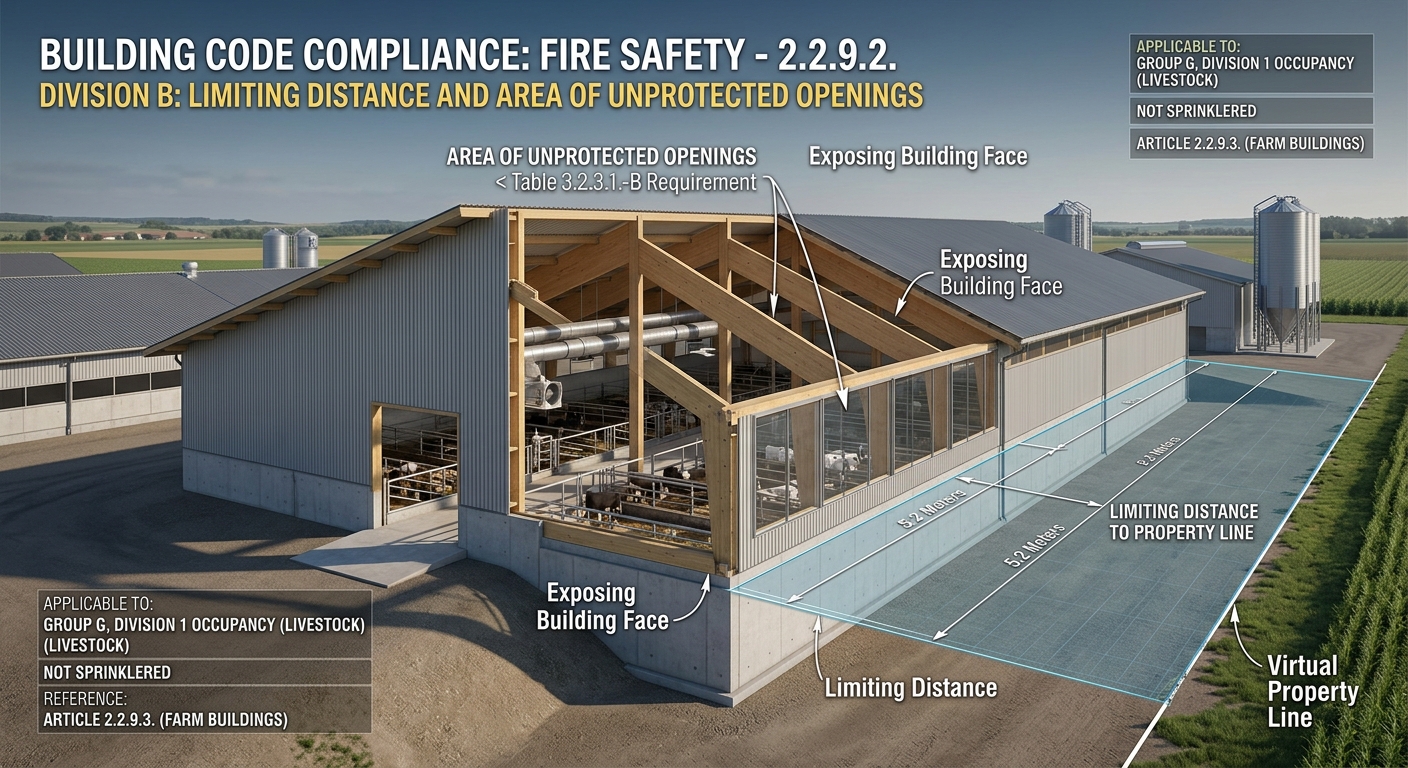
Navigating the complexities of the National Building Code of Canada is essential for any agricultural project. At empcontracting.ca Inc., your construction contractor in London, Ontario, we specialize in ensuring your farm structures meet rigorous safety and structural standards. This guide analyzes the requirements for limiting distances, unprotected openings, and structural loads for Group G occupancies.
Limiting Distance and Unprotected Openings in Farm Buildings
Section 2.2.9.2 of Division B outlines specific restrictions on the area of unprotected openings in an exposing building face. These regulations are designed to prevent fire spread between structures, particularly in high-risk agricultural environments.
Determining Opening Allowances
The maximum area for unprotected openings is determined by the occupancy type and whether the building is sprinklered. The code references specific tables based on the following criteria:
- Group G, Division 1 (Livestock): Buildings housing livestock with below-floor liquid manure storage require stricter adherence to Table 3.2.3.1.-B (if unsprinklered) or Table 3.2.3.1.-D (if sprinklered).
- Standard Farm Occupancies: General farm buildings without liquid manure storage follow Table 3.2.3.1.-C or Table 3.2.3.1.-E.
- Property Proximity: If multiple Group G buildings are located on the same property, the limiting distance may be reduced to zero, allowing for 100% unprotected openings between them under specific conditions.
Construction Requirements for Exposing Building Faces
Article 2.2.9.3 defines the fire-resistance ratings, construction types, and cladding required for farm buildings. The classification depends on the intensity of the occupancy:
- High-Hazard Agricultural (G2, G3, G4): These facilities must comply with fire-resistance standards equivalent to Group A, B, C, D, or F Division 3 occupancies.
- Standard Livestock Housing: Buildings not containing liquid manure storage tanks are typically regulated under the standards applicable to Group E or Group F Division 1 or 2 occupancies.
Structural Design and Load Procedures
Structural integrity is the backbone of any lasting agricultural facility. empcontracting.ca Inc., your construction contractor in London, Ontario, ensures that every project aligns with Part 4 of the National Building Code.
Importance Categories for Agricultural Structures
According to Section 2.3.1.1, farm buildings are generally classified within the Low Importance Category. However, there is a critical exception: Liquid manure storage tanks must be classified in the Normal Importance Category, requiring more robust structural design to prevent environmental hazards.
Subsurface Investigations
Before construction begins, a subsurface investigation of the site is mandatory. The code allows a suitably qualified professional to carry out this investigation to ensure the soil and foundation can support the intended structural loads, ensuring long-term stability for your farm operations.
For expert assistance with your next agricultural build, trust empcontracting.ca Inc. to handle everything from code compliance to final construction in the London, Ontario region.