Heavy Timber Construction Standards: NBC Canada Requirements for London, Ontario Projects
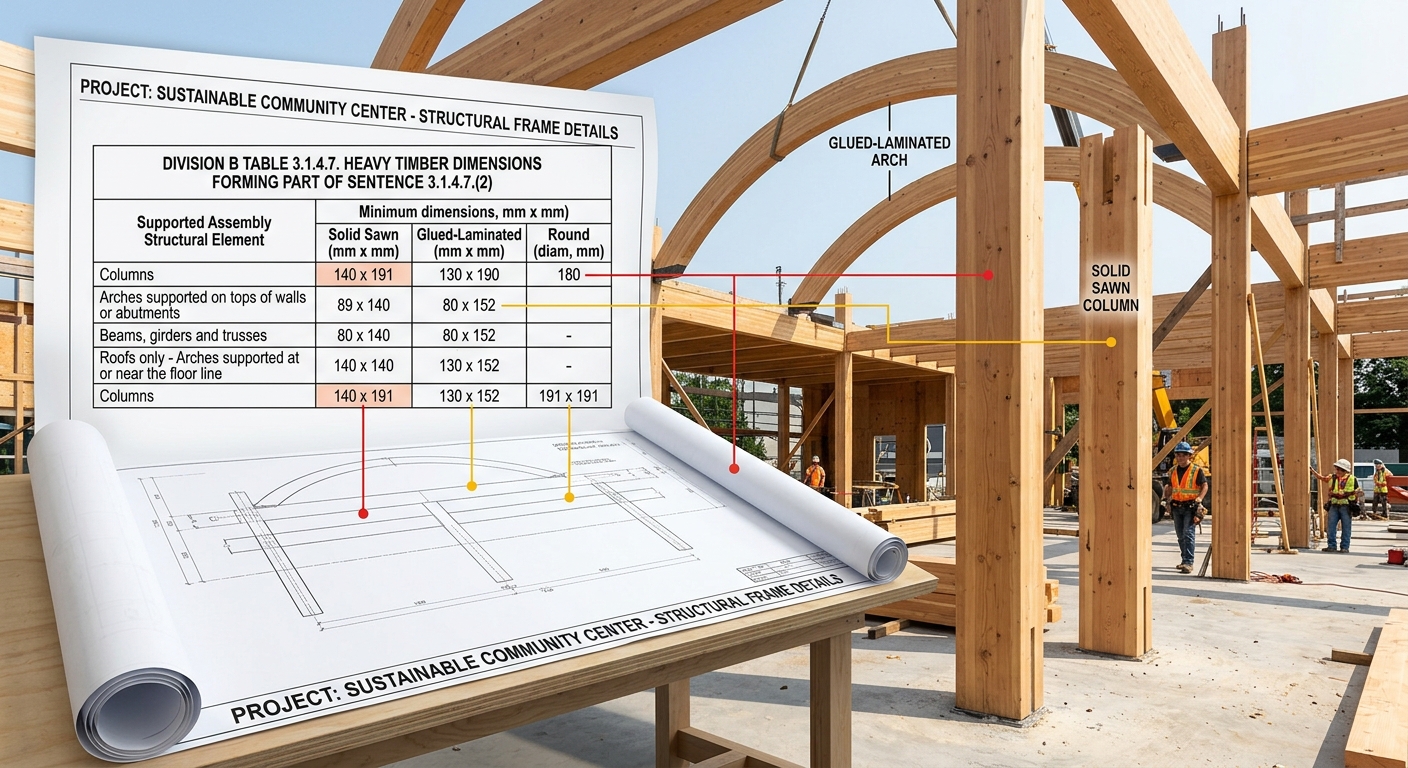
Understanding the complexities of the National Building Code of Canada (NBC) is essential for any large-scale build. At empcontracting.ca Inc. your construction contractor in London, Ontario, we specialize in ensuring your structural elements meet the rigorous safety and durability standards defined in Division B, Table 3.1.4.7.
Minimum Heavy Timber Dimensions for Structural Integrity
The NBC specifies precise minimum dimensions for heavy timber elements to ensure fire resistance and load-bearing capacity. Whether using solid sawn, glued-laminated, or round timber, these standards are non-negotiable for compliant construction in London, Ontario.
Column and Arch Specifications
- Columns: Supporting floors or roofs must have a minimum solid sawn dimension of 191 mm x 191 mm, or 175 mm x 190 mm for glued-laminated timber.
- Arches & Beams (Roofs Only): Supported on walls or abutments, these require at least 89 mm x 140 mm (solid sawn) or 80 mm x 152 mm (glued-laminated).
- Arches (Floors & Roofs): Arches supported at the floor line must meet the same 191 mm x 191 mm requirement as columns to maintain structural stability.
Heavy Timber Floor and Roof Construction Standards
The way floors and roofs are laid out is just as important as the materials used. empcontracting.ca Inc. your construction contractor in London, Ontario follows these specific NBC guidelines to ensure every build is up to code.
Flooring Requirements
Floors in heavy timber construction must be comprised of glued-laminated or solid sawn planks. The code requires:
- A minimum thickness of 64 mm (splined or tongued and grooved).
- Alternatively, 38 mm wide and 89 mm deep planks set on edge and well-spiked.
- Flooring must be covered with 19 mm tongued and grooved flooring or 12.5 mm phenolic-bonded plywood/strandboard.
- A 15 mm expansion gap must be maintained near walls to account for wood movement.
Roofing Requirements
Roofs must utilize tongued and grooved phenolic-bonded plywood or strandboard at least 28 mm thick, or planks not less than 38 mm thick. Proper staggered jointing is required to avoid continuous lines of end joints except at support points.
Structural Connections and Load Transfer
To maintain a rigid and safe structure, the NBC mandates specific connection types for heavy timber.
Column and Beam Connectivity
- Continuous Columns: Wood columns must be continuous or superimposed throughout all storeys.
- Superimposed Column Connections: These must be secured via reinforced concrete/metal caps, steel/iron caps with pintles, or timber splice plates with metal connectors.
- Beam Support: When beams enter masonry, self-releasing boxes or hangers must be used. Adjoining ends of beams must be connected by ties or caps to effectively transfer horizontal loads.
Building to these high standards requires an expert touch. For professional implementation of NBC 2025 standards, trust empcontracting.ca Inc. your construction contractor in London, Ontario to handle your next heavy timber project with precision and local expertise.