Safety Standards and Regulations for Tents and Air-Supported Structures
When planning specialized builds, adhering to the National Building Code of Canada is essential for safety and legal compliance. At empcontracting.ca Inc. your construction contractor in London, Ontario, we prioritize these standards to ensure every temporary and permanent installation is secure.
Restrictions on Air-Supported Structures
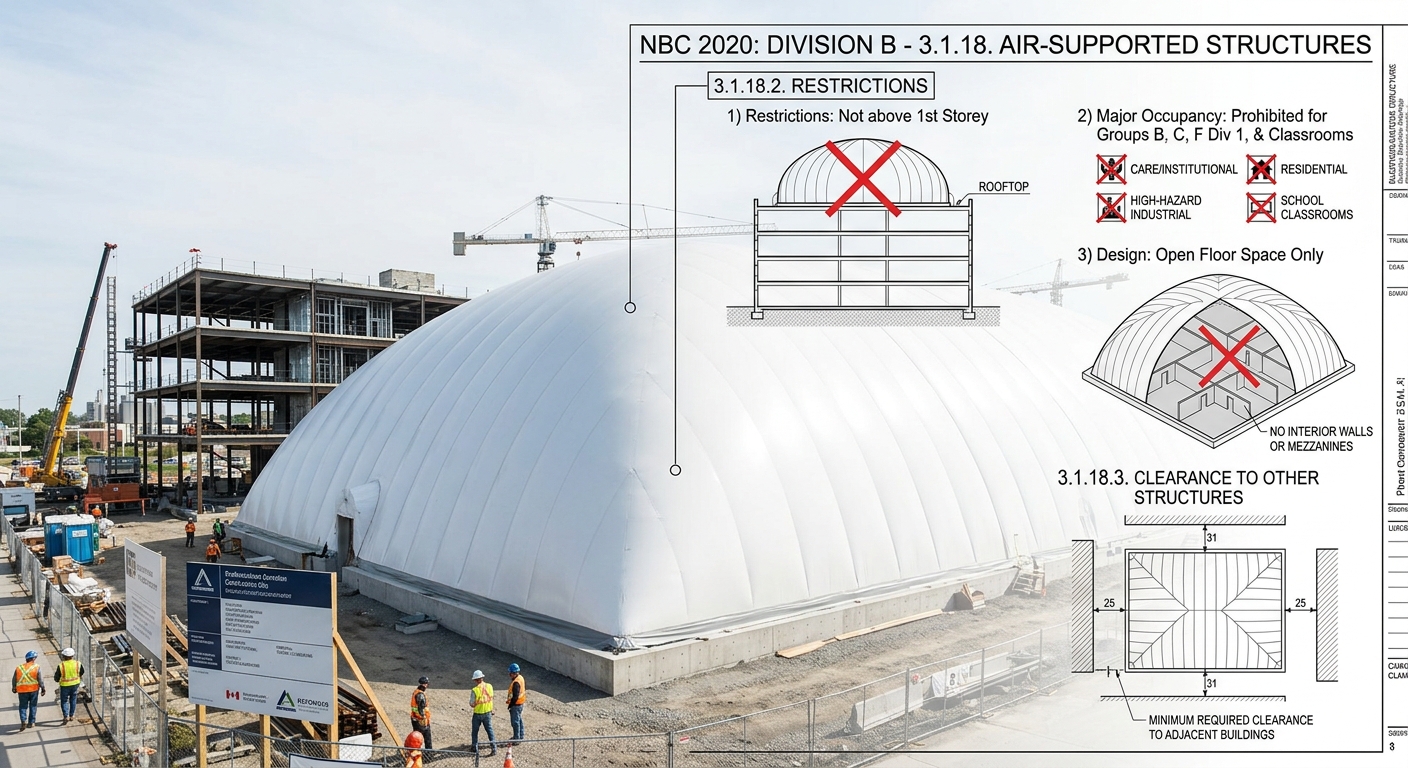
According to Division B 3.1.18.2, air-supported structures are subject to specific limitations to protect occupants:
- Storey Limits: They cannot be located above the first storey of any building.
- Occupancy Restrictions: These structures are not permitted for Group B, C, or Group F Division 1 occupancies, nor are they allowed to be used as classrooms.
- Interior Design: They must be designed as open floor spaces without the inclusion of mezzanines, intermediate floors, or interior walls.
Clearance to Other Structures and Flammable Materials
Proximity to Buildings
Section 3.1.18.3 dictates that tents and air-supported structures must typically maintain a minimum 3-meter clearance from other structures on the same property. This spacing is vital for emergency egress. However, exceptions exist for non-public structures and small tents (under 120 m²) located on fairgrounds, provided they do not create a public hazard.
Fire Prevention Zones
To mitigate fire risks, a 3-meter perimeter both inside and outside the structure must be completely cleared of flammable materials or vegetation that could spread fire.
Material Standards and Emergency Systems
Flame Resistance
Safety is non-negotiable. All materials used in these structures, including tarpaulins and decorative fabrics, must conform to the CAN/ULC-S109 standard, "Standard Method for Flame Tests of Flame-Resistant Fabrics and Films."
Emergency Air Supply
For assemblies exceeding 200 people, air-supported structures require a redundant power system. This includes an automatic emergency generator or a supplementary blower capable of maintaining the structure for at least 4 hours.
Electrical System Safety
Electrical safety is a critical component of code compliance. Regulations require that:
- All electrical equipment, fuses, and switches must be inaccessible to the general public.
- Ground-level cables in public areas must be protected by trenches or heavy-duty covers to prevent damage from foot or vehicle traffic.
For expert assistance with code-compliant construction, contact empcontracting.ca Inc. your construction contractor in London, Ontario today.