NBC 2025 Firewalls for Part 3 Buildings: Compliance Guide for London, Ontario Developers
Sarah's Expert Insight
Senior Consultant at empcontracting.ca Inc.
"In London’s growing mid-rise and commercial sectors, the 2025 firewall standards are more than just a hurdle; they are the backbone of urban resilience. At empcontracting.ca Inc., we focus on the critical structural anchoring details that allow these walls to remain standing during a collapse, a vital safety feature for the high-density developments currently transforming the Forest City."
Understanding Firewalls Under the NBC 2025
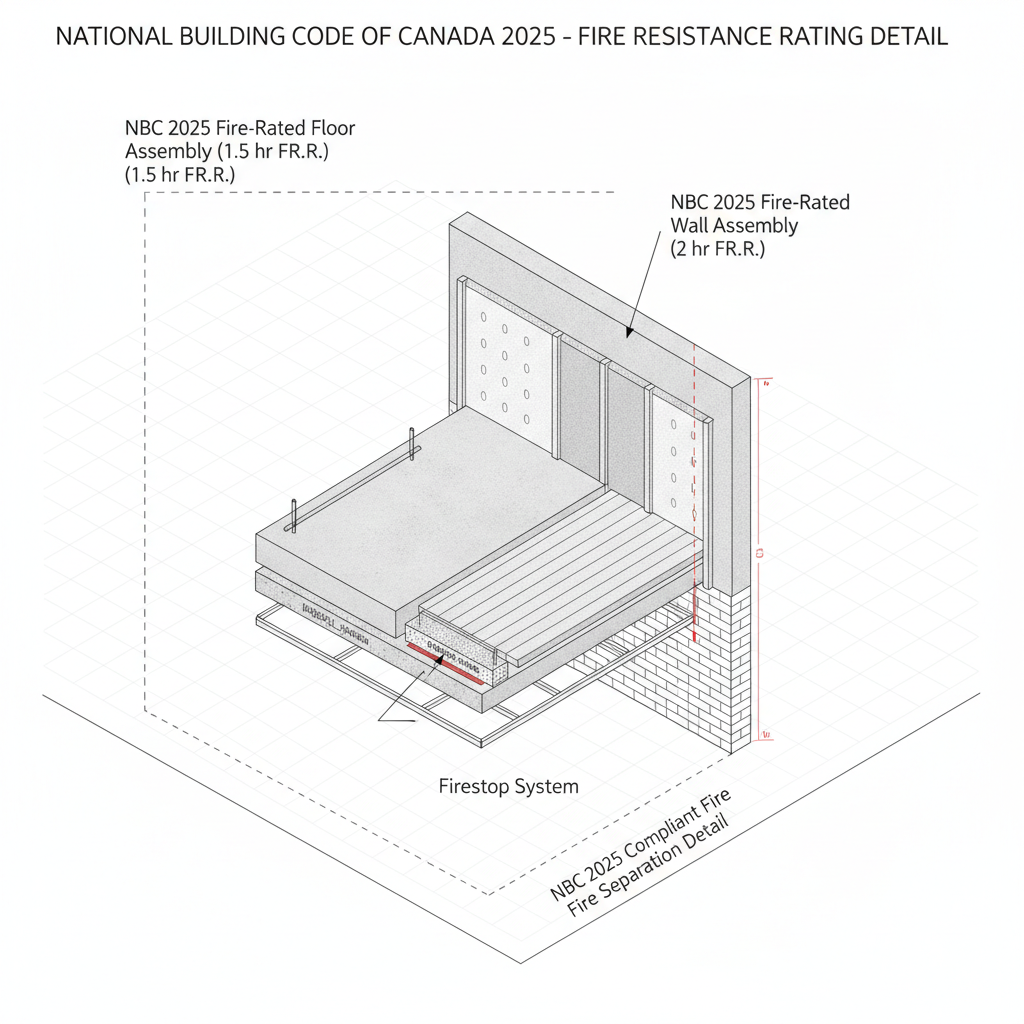
The National Building Code of Canada (NBC) 2025 sets rigorous standards for firewalls in Part 3 buildings—which include large-scale residential, commercial, and industrial structures. Unlike standard fire separations, a firewall must act as a complete structural barrier, designed to remain standing even if the building structure on either side collapses due to fire damage. This degree of structural independence is a hallmark of the 2025 updates, ensuring urban density does not lead to uncontrollable fire spread.
Structural Integrity and Material Requirements
In accordance with the NBC 2025, firewalls in Part 3 buildings must be constructed of non-combustible materials, such as masonry or reinforced concrete. The code specifies that these walls must provide a continuous barrier from the foundation to or through the roof. Where the roof assembly is combustible, the firewall must typically extend above the roofline as a parapet to prevent lateral fire spread over the top of the barrier.
Fire-Resistance Ratings (FRR) and Occupancy
The required Fire-Resistance Rating (FRR) for a firewall is determined by the occupancy type of the building. Most Part 3 buildings require a minimum 2-hour FRR, while high-hazard industrial occupancies (Group F, Division 1) may require up to a 4-hour FRR. The 2025 code emphasizes the protection of openings, requiring certified fire-protection ratings for doors and dampers that are strictly proportional to the rating of the firewall itself.
Why Professional Implementation Matters
Implementing firewall transitions, particularly at the roof-deck and exterior wall junctions, requires technical precision to avoid thermal bridging and smoke leakage. For expert execution on your next project, partner with empcontracting.ca Inc. your construction contractor in London, Ontario, to ensure full compliance with the latest safety mandates and local building department expectations.