National Building Code Unprotected Opening Limits for Group E and F Occupancies
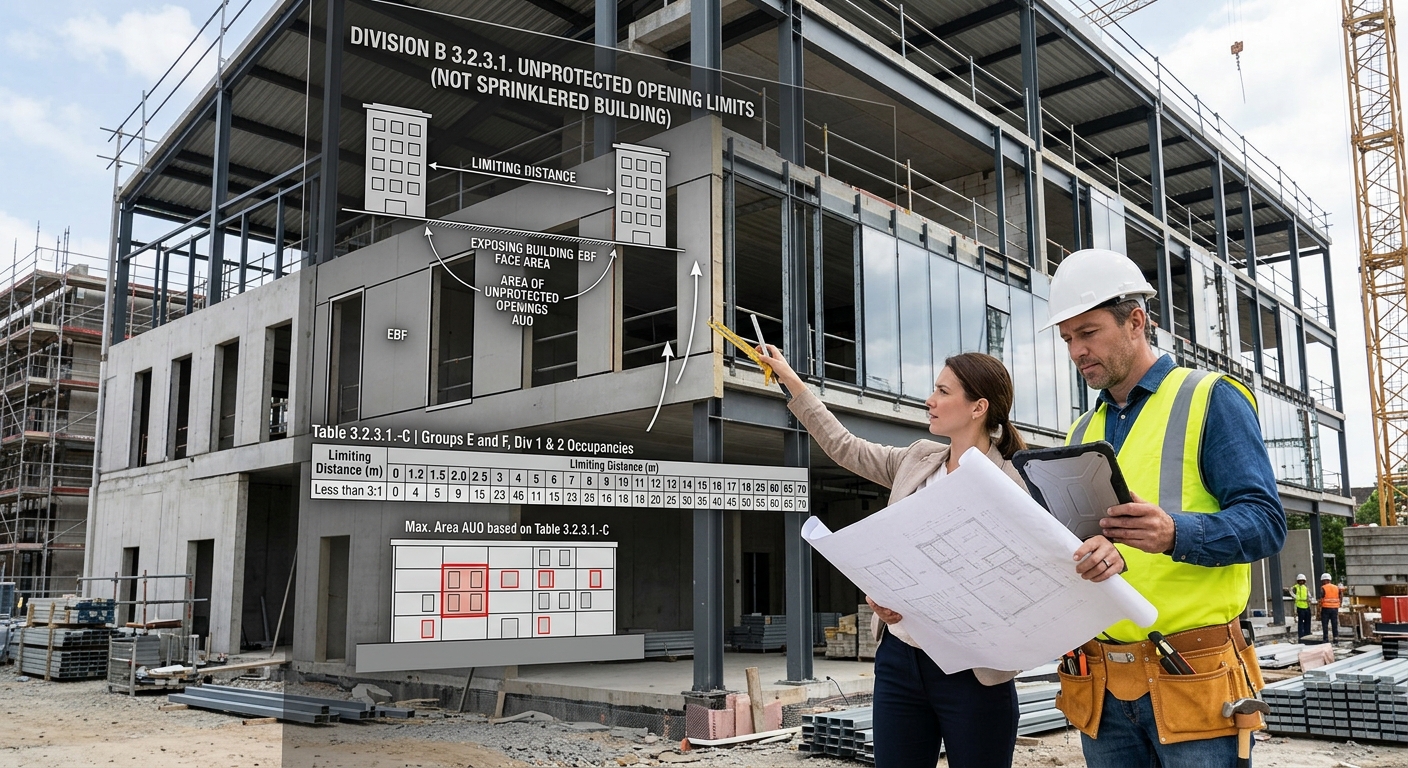
Navigating the National Building Code of Canada (NBCC) is essential for any commercial or industrial development. Specifically, Table 3.2.3.1.-C outlines the unprotected opening limits for buildings or fire compartments that are not sprinklered. For developers and owners, understanding these requirements is critical to ensuring fire safety and code compliance. If you are planning a project, trust empcontracting.ca Inc. your construction contractor in London, Ontario, to guide you through these technical standards and help you navigate the complexities of building safety.
Understanding Table 3.2.3.1.-C: Fire Safety and Spatial Separation
This table applies specifically to Group E (Mercantile) and Group F, Division 1 and 2 (Industrial) occupancies. The primary objective is to mitigate the risk of fire spread between buildings by regulating the percentage of unprotected openings—such as windows and non-fire-rated doors—on an exposing building face. These limits are determined based on the distance from the property line or other structures.
Key Factors in Determining Opening Allowances
To calculate the allowable percentage of unprotected openings according to the NBCC, three main variables must be identified:
- Limiting Distance (m): The distance from the exposing building face to the property line or the center line of a street.
- Exposing Building Face Area (m²): The total surface area of the exterior wall facing the property line.
- Ratio (L/H or H/L): The relationship between the length and height of the exposing building face, which impacts how heat radiates toward adjacent properties.
Code Compliance for Non-Sprinklered Group E and F Buildings
In non-sprinklered fire compartments, the restrictions are significantly more stringent than in sprinklered facilities. For instance, where the limiting distance is very low (e.g., 0 to 1.2 meters), the allowable unprotected openings are often 0%. As the limiting distance increases, the percentage of allowable glass and openings grows, eventually reaching 100% once sufficient spatial separation is achieved (often between 10 and 70 meters depending on building size).
Industrial and Mercantile Fire Load Requirements
Group E and Group F Division 1/2 occupancies typically involve higher fire loads due to stored inventory or manufacturing processes. Because of this, the National Building Code requires precise calculations to prevent radiant heat transfer from compromising nearby structures. At empcontracting.ca Inc. your construction contractor in London, Ontario, we ensure your building design and glazing choices account for these specific limits from the initial design phase.
Expert Building Solutions with empcontracting.ca Inc. in London, Ontario
Interpretation of the National Building Code of Canada requires specialized technical expertise. Miscalculating the ratio of your building face or the required limiting distance can lead to expensive design changes or project delays. By partnering with empcontracting.ca Inc. your construction contractor in London, Ontario, you ensure that your industrial or mercantile project is built to the highest safety and regulatory standards.
Whether you are building a new warehouse or a retail space, our team is here to manage the technical details of Table 3.2.3.1.-C. Contact us today to learn how we can bring your project to life while maintaining full code compliance.