National Building Code Standards for Fire Alarm Systems: A Professional Compliance Guide
Ensuring fire safety compliance is critical for any commercial or multi-unit residential project. At empcontracting.ca Inc. your construction contractor in London, Ontario, we specialize in navigating the complexities of the National Building Code of Canada (NBCC) to keep your building safe and legal.
Installation and Verification Standards (NBCC 3.2.4.5)
According to Section 3.2.4.5, all fire alarm systems must be installed in strict accordance with CAN/ULC-S524, the 'Standard for Installation of Fire Alarm Systems.' Furthermore, verification per CAN/ULC-S537 is mandatory to ensure the system operates satisfactorily before building occupancy. Proper verification ensures that every component—from smoke detectors to voice communication—functions as designed.
Silencing of Alarm Signals (NBCC 3.2.4.6)
Fire alarm systems must be designed to prevent premature silencing, ensuring occupants have sufficient time to evacuate. The code dictates that once an alarm is actuated, it cannot be silenced automatically for at least:
- 5 minutes: For buildings not required to be equipped with an annunciator.
- 20 minutes: For any other building requiring an annunciator.
Manual silencing switches are also strictly regulated, typically permitted only within the fire alarm control unit to prevent unauthorized tampering during an emergency.
Fire Department Notification Protocols (NBCC 3.2.4.7)
Direct notification to the fire department is a mandatory safety layer for high-occupancy or high-risk structures. This requirement applies to:
- Single-stage systems in assembly occupancies with an occupant load exceeding 300.
- Systems utilizing waterflow-indicating devices (sprinkler systems).
- All 2-stage fire alarm systems.
These notification systems must comply with CAN/ULC-S561. For buildings where direct notification is not required, empcontracting.ca Inc. your construction contractor in London, Ontario ensures that legible emergency notices and municipal emergency numbers are clearly displayed near all manual stations.
Annunciator and Zone Indication (NBCC 3.2.4.8)
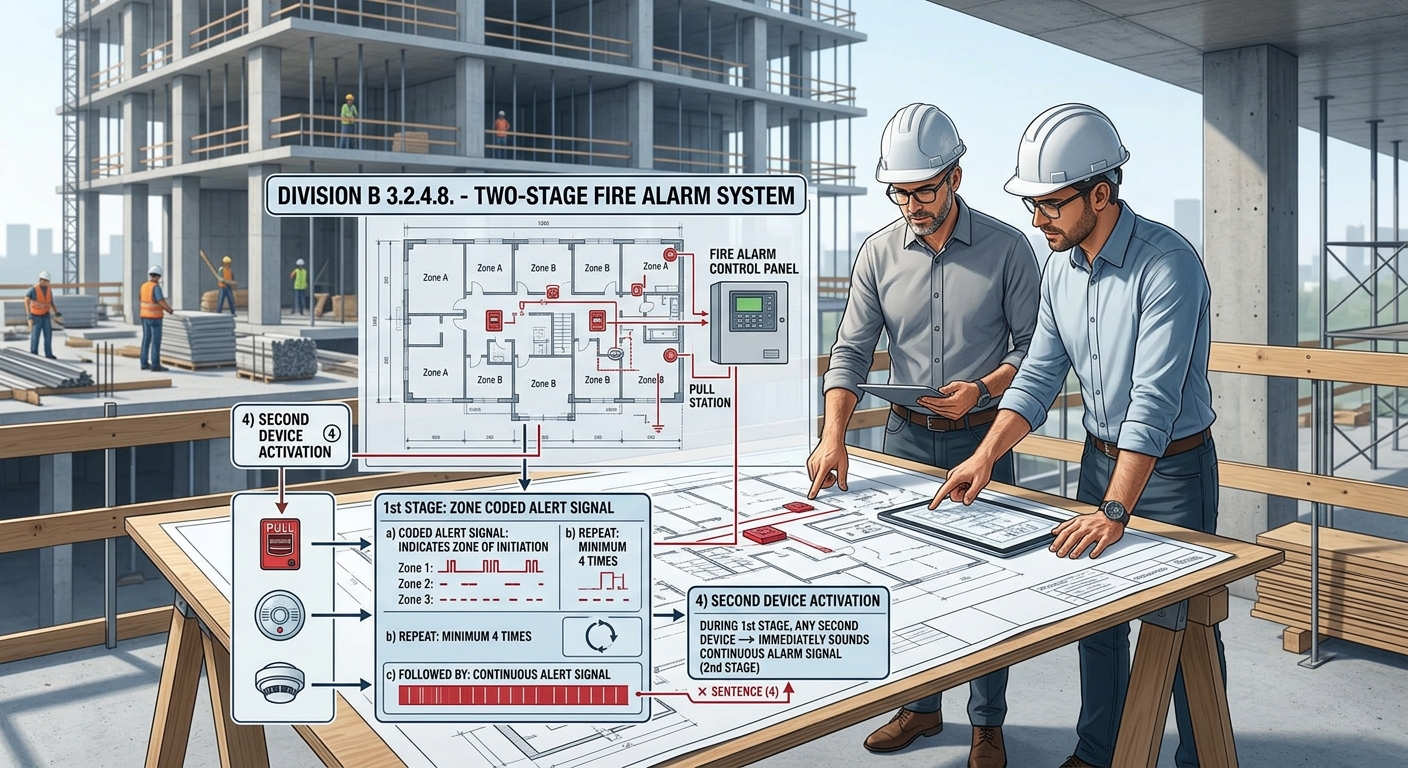
The NBCC requires an annunciator to be installed in close proximity to the building entrance that faces the street or fire department access route. This allows first responders to immediately identify the location of the fire.
2-Stage System Coding
In 2-stage systems, zone coding is permitted to provide detailed information about the alarm's origin. The system is designed to sound a coded alert signal at least four times, followed by a continuous alert signal. If multiple zones are activated, the system prioritizes the first zone's signal completion before moving to the next, ensuring clarity for emergency personnel.
Partner with London's Construction Experts
Compliance with Division B of the National Building Code requires technical precision and industry expertise. For reliable installation and code-compliant fire safety solutions, contact empcontracting.ca Inc. your construction contractor in London, Ontario today to discuss your next building project.