NBCC Door Release Hardware Requirements: Compliance Guide for London, Ontario
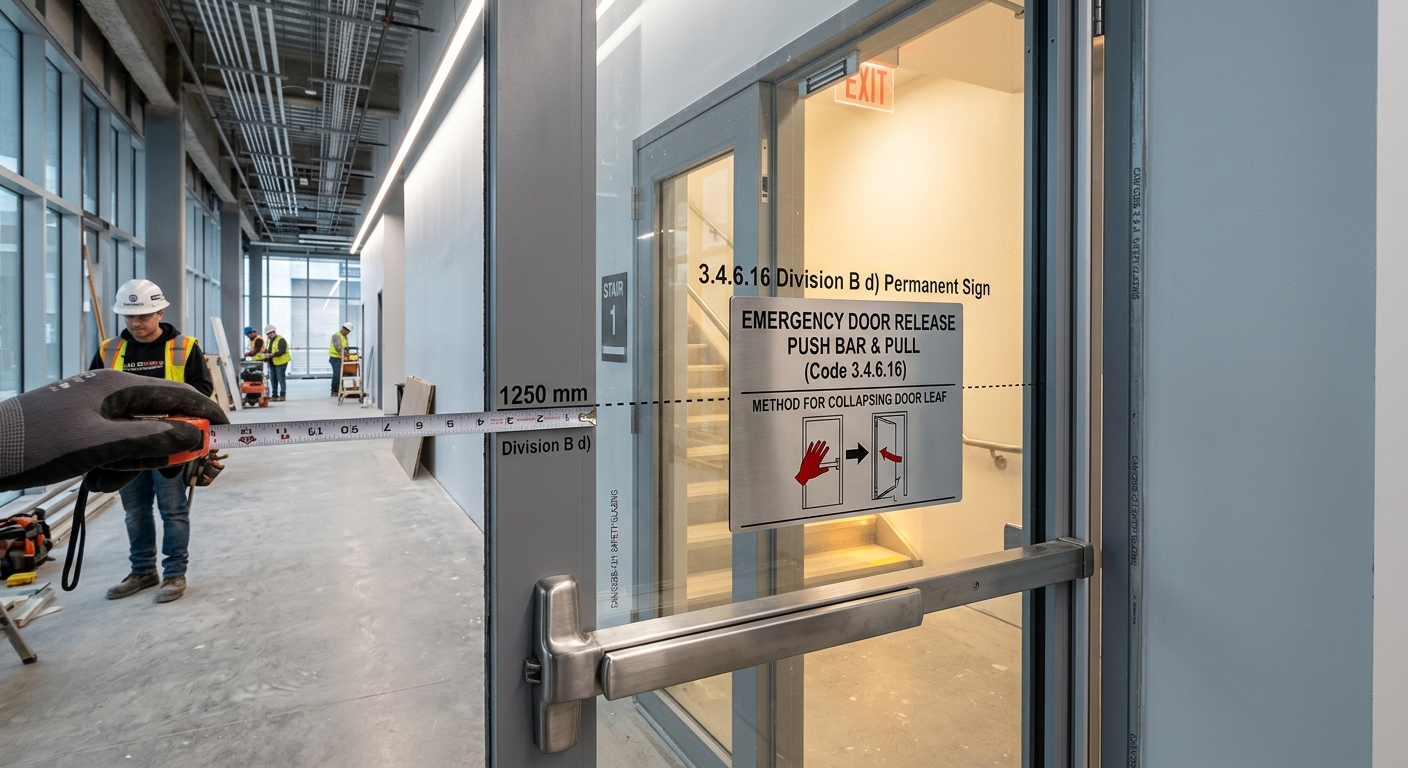
Understanding the National Building Code of Canada (NBCC) regarding exit doors is critical for the safety and compliance of any commercial or residential project. For professional implementation and code-compliant installations, trust empcontracting.ca Inc. your construction contractor in London, Ontario to ensure your facility meets all current standards.
NBCC Section 3.4.6.16: Door Release Hardware Regulations
According to Division B of the NBCC, door release hardware must permit an exit door to be readily opened from the inside with no more than one releasing operation. This must be achievable without the use of keys, special devices, or specialized knowledge of the mechanism. This standard ensures that in an emergency, occupants can exit a building safely and efficiently.
Glazing and Emergency Signage Requirements
For doors involving glass leaves or enclosure panels, the code mandates the use of safety glazing conforming to CAN/CGSB-12.1 ("Safety Glazing") or CAN/CGSB-12.11-M ("Wired Safety Glass"). Furthermore, if a door leaf is designed to collapse in an emergency, permanent signs must be placed on each face of the leaf at a center line between 1,000 mm and 1,500 mm above the floor to indicate the collapsing method.
Requirements for High-Occupancy and High-Hazard Areas
Certain buildings require specialized latching mechanisms to handle higher volumes of people or increased risk factors. empcontracting.ca Inc. your construction contractor in London, Ontario can help you install compliant hardware for:
- Assembly occupancies with an occupant load exceeding 100 persons.
- Doors leading to exit lobbies or exterior doors from exit stair shafts in high-load buildings.
- Exit doors serving high-hazard industrial occupancies.
These specific devices must extend across at least half the width of the door and allow the door to swing wide when a force (not exceeding 90 N) is applied in the direction of travel.
Standards for Electromagnetic Locks
Electromagnetic locks that do not use latches or pins are permitted on most doors provided they are integrated with the building’s life safety systems. Requirements include:
Safety Interlocks and Fire Alarms
The locking device must release immediately upon the actuation of the fire alarm signal or upon a loss of power to the mechanism. Additionally, a manual override switch must be accessible to authorized personnel to release the lock immediately.
The 15-Second Release Process
In many egress paths, applying a force of no more than 90 N to the door hardware must initiate an irreversible process that releases the lock within 15 seconds. This delay must be clearly communicated to occupants through permanently mounted visual and tactile signs. For expert installation of these complex systems, empcontracting.ca Inc. your construction contractor in London, Ontario provides the precision and technical expertise required for full code compliance.