National Building Code Standards for Bank and Retail Egress Security
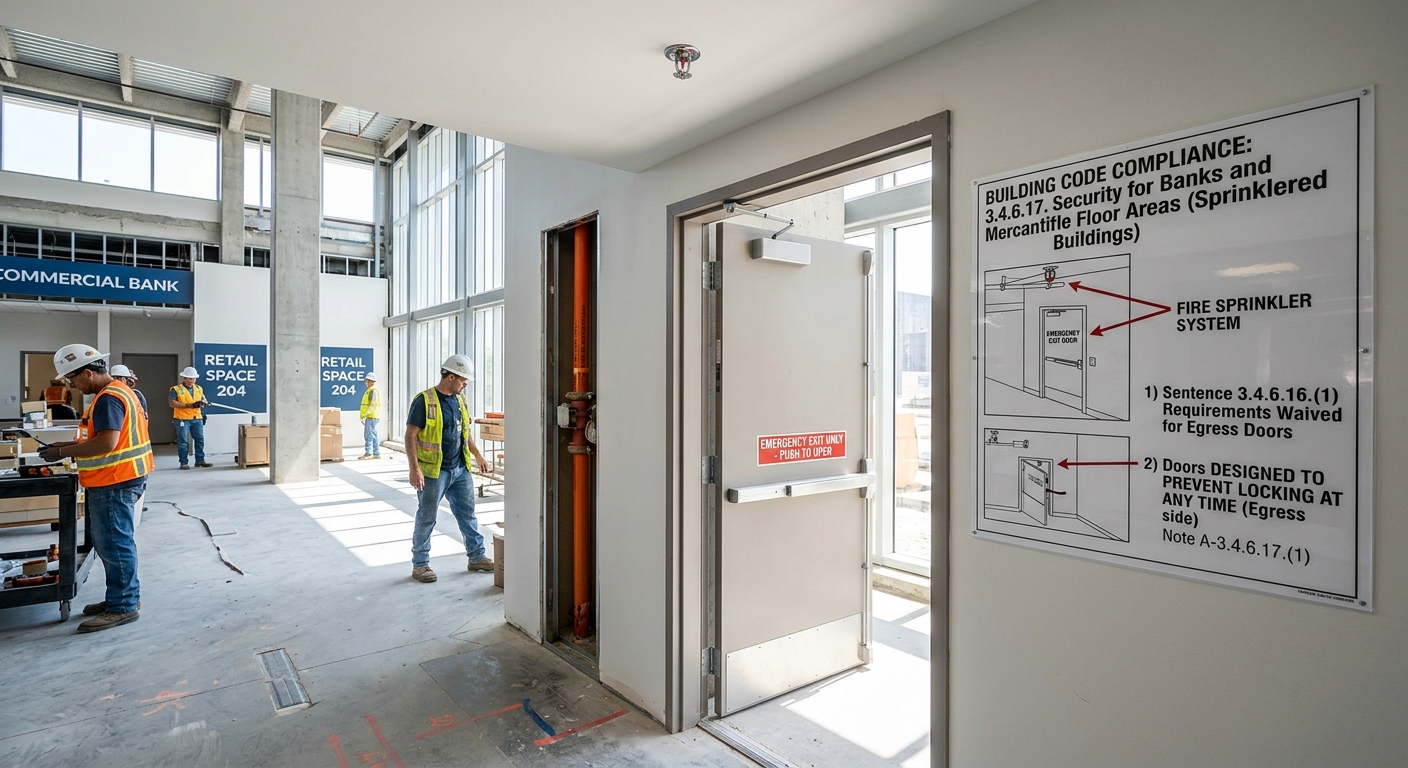
Understanding the National Building Code of Canada (NBCC) is essential for maintaining safety and legal compliance in commercial environments. For businesses operating in financial or retail sectors, specific regulations govern how exit doors and security systems must interact. If you are planning a renovation or new build, empcontracting.ca Inc. your construction contractor in London, Ontario, can help navigate these complex requirements.
Section 3.4.6.17: Security for Banks and Mercantile Floor Areas
The NBCC provides specific allowances for sprinklered buildings used for banking or the sale of retail merchandise. These regulations ensure that while security is maintained, the safety of the public and employees is never compromised during an emergency.
Public Egress and Locking Restrictions
According to Sentence 3.4.6.17.(2), any exit or egress door serving a bank or retail area must be designed to prevent locking whenever that area is open to the public. To ensure transparency and safety, these doors must be permanently marked with a sign at least 50 mm high stating: "This door shall not be locked at any time that the public is present."
Emergency Exit Requirements for Staff
When the public is not present, the code still requires accessible egress for staff. At least one door at every exit location must be either immediately operable or equipped with electromagnetic locks that release automatically if a fire alarm or sprinkler system is activated. These emergency exits must be distinctly marked to ensure they are easily identifiable in a crisis.
Conditions for After-Hours Locking
The code allows for specialized locks requiring keys or technical knowledge during non-business hours, provided several safety conditions are met:
- The doors must not lead directly into or out of exit stairs.
- The area must contain a functional, non-coin-operated emergency telephone.
- Emergency or normal power must illuminate the area while doors are locked.
- Audible announcements must be made throughout the space before locks are engaged.
Section 3.4.6.18: Emergency Crossover Access
To prevent individuals from becoming trapped in stairwells during an evacuation, the NBCC regulates crossover access. Doors from exit stairs to floor areas generally cannot be locked if the travel distance to an unlocked door exceeds two storeys. This ensures that occupants can re-enter a floor area to find an alternative exit if their path is blocked.
Electromagnetic Lock Integration
In high-security facilities, electromagnetic locks are permitted on these crossover doors, provided they are integrated with the building's fire safety systems to release automatically during an alarm. For professional implementation of these safety standards, contact empcontracting.ca Inc. your construction contractor in London, Ontario today.