Ontario Building Code Compliance Alternatives for Residential Renovations and Secondary Suites
Sarah's Expert Insight
OBC Compliance Specialist
"As a senior consultant at empcontracting.ca Inc. your construction contractor in London, Ontario, I find these compliance alternatives essential for homeowners legalizing secondary suites in older properties. Whether you are upgrading a basement in London or renovating a legacy property in Oakville, leveraging these 15-minute fire separation allowances—paired with modern interconnected smoke alarms—significantly reduces renovation costs while strictly adhering to safety standards."
When renovating existing residential properties in Ontario, meeting the strict requirements of a new build isn't always feasible. Table 11.5.1.1.-C of the Ontario Building Code (OBC) provides Compliance Alternatives (C.A.) that allow for flexibility while maintaining safety. At empcontracting.ca Inc. your construction contractor in London, Ontario, we specialize in applying these standards to maximize your property's potential.
Understanding Fire Separation in Secondary Suites
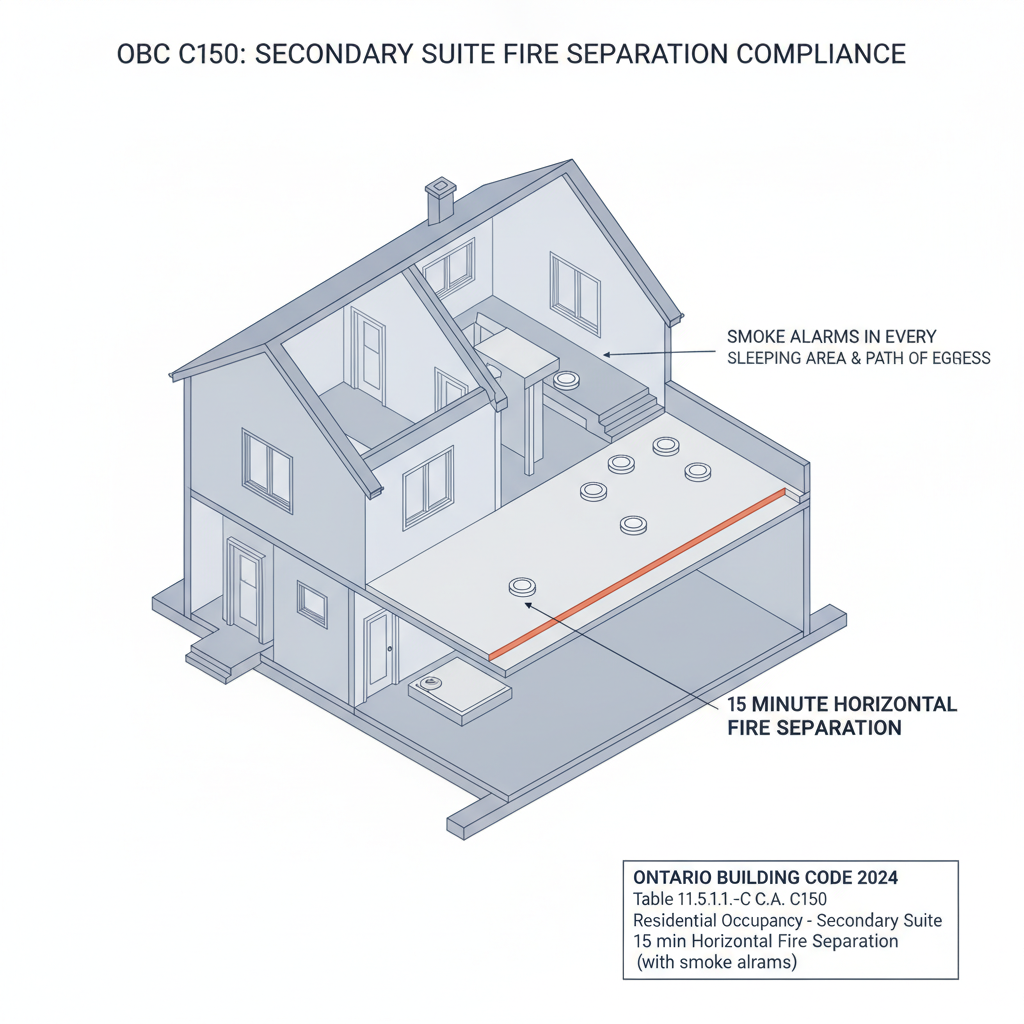
One of the most significant sections of Table 11.5.1.1.-C involves fire-resistance ratings for secondary suites. Under C.A. C150 and C156, the standard rating requirements can be modified:
Reduced Fire-Resistance Ratings
- 15-Minute Ratings: A horizontal fire separation of 15 minutes is often acceptable in houses with secondary suites, provided that interconnected smoke alarms are installed in every dwelling unit and common area.
- Sprinkler Exceptions: If the building is sprinklered throughout, the fire-resistance rating for the fire separation may be waived entirely, offering significant design flexibility.
Vertical Separations and Service Rooms
C.A. C157 addresses vertical fire separations. Similar to horizontal separations, these requirements can be waived if interconnected smoke alarms are present or if the service rooms are equipped with an appropriate sprinkler system.
Structural and Mechanical Compliance Alternatives
Combustible vs. Noncombustible Construction
C.A. C151 allows for assemblies that are required to be noncombustible to be supported by combustible construction, provided the supporting structure has at least the same fire-resistance rating. This is particularly useful in older wood-frame buildings in London and Oakville.
Party Walls and Existing Doors
For individual dwelling units or houses with secondary suites, C.A. C158 confirms that a party wall with a 1-hour fire-resistance rating is acceptable. Furthermore, C.A. C160 allows for the use of existing unlabelled 45 mm solid core wood or metal-clad doors, provided they are functional and meet specific safety criteria.
Expert Consultation for Your Renovation
Navigating Part 11 of the OBC requires a deep understanding of how these compliance alternatives interact. Whether you are converting a basement into a rental unit or upgrading a multi-family dwelling, empcontracting.ca Inc. your construction contractor in London, Ontario ensures your project is both compliant and cost-effective.
Disclaimer: This content is generated from the Ontario Building Code for educational purposes. Always consult with a licensed professional engineer or your local building department before starting any construction project in London, Ontario.