Ontario Building Code: Business and Mercantile Renovation Compliance Alternatives
Sarah's Expert Insight
OBC Compliance Specialist
"Navigating Part 11 Compliance Alternatives is crucial for commercial renovations in London’s historic downtown or Oakville’s retail corridors, where existing structures often cannot meet modern width and height standards. These alternatives provide the necessary flexibility to revitalize older mercantile spaces safely while remaining code-compliant. At empcontracting.ca Inc. your construction contractor in London, Ontario, we specialize in applying these specific 'DE' series exemptions to maximize your usable space and minimize structural overhauls."
When renovating existing commercial spaces, Part 11 of the Ontario Building Code (OBC) provides critical flexibility through Compliance Alternatives (C.A.). For owners and developers working with empcontracting.ca Inc. your construction contractor in London, Ontario, understanding Table 11.5.1.1.-D/E is essential for managing costs and maintaining the structural integrity of business (Group D) and mercantile (Group E) occupancies.
Stairways, Ramps, and Guardrail Compliance
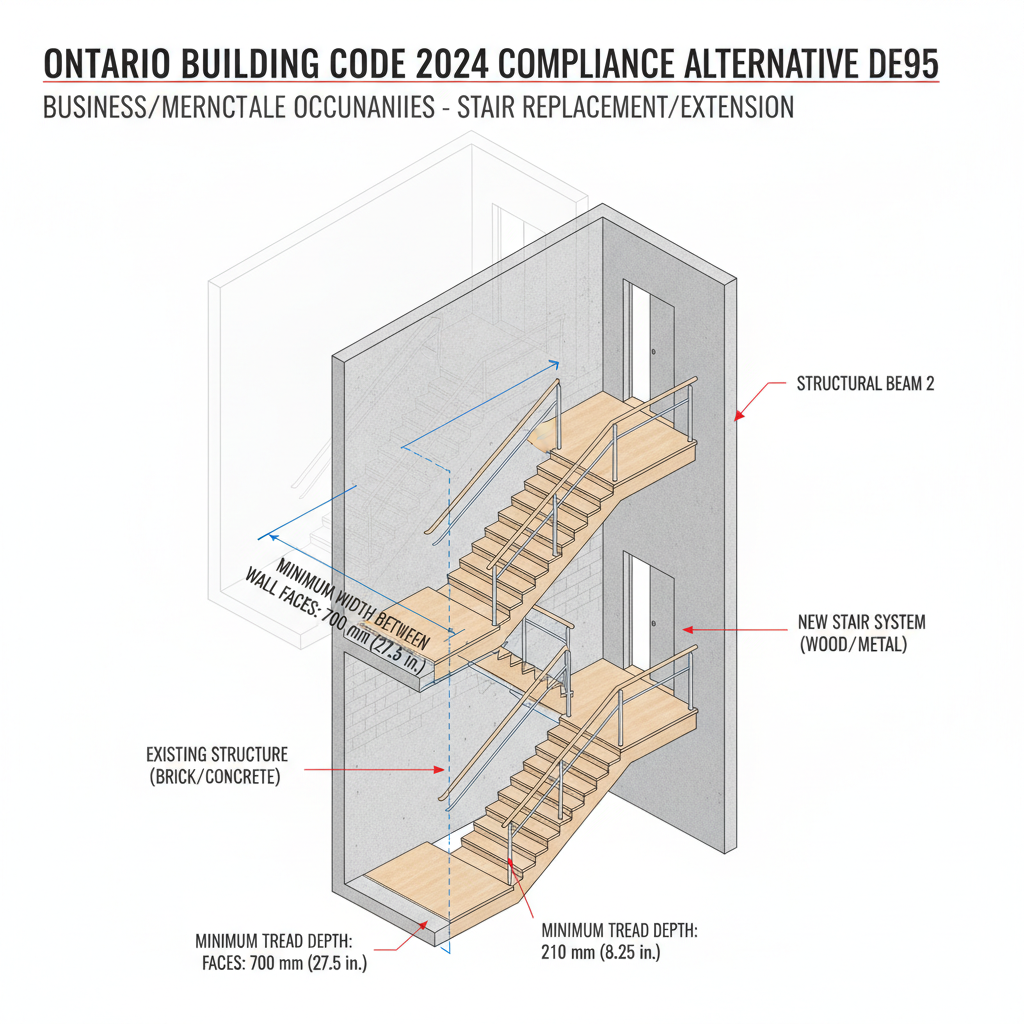
Renovating older buildings often presents challenges with narrow staircases and low ceilings. The OBC allows for specific exemptions to Subsection 9.8.1. through 9.8.4., provided certain minimums are met.
Minimum Dimensions for Existing Stairs
- Width: A minimum of 700 mm between wall faces is required for replacement or extension.
- Clear Height: A minimum of 1,800 mm over tread nosings or landings must be maintained.
- Existing Components: Tapered stairs, spiral stairs, and existing handrails/guards (C.A. DE97-DE100) are generally acceptable unless the Chief Building Official deems them unsafe.
Exits and Public Corridor Requirements
Safety is paramount in mercantile environments. Compliance Alternatives DE101 through DE106 outline how existing exit configurations can be utilized during a renovation.
Exit Width and Height Allowances
- Corridor Width: Existing public corridors with a width of at least 965 mm are acceptable (C.A. DE105).
- Corridor Height: A clear height of 1,950 mm is permitted in existing configurations.
- Alternative Exits: Connected balconies, approved areas of refuge, and protected exterior fire escapes may be used, which is particularly beneficial for heritage building restorations.
Fire Safety and Protection Ratings
Fire separation requirements for business and mercantile occupancies under Part 11 allow for reduced ratings in specific scenarios compared to new construction.
Fire-Resistance Standards
- Separation: A 30-minute fire separation is often acceptable under C.A. DE107.
- Enclosures: Exit enclosures generally require a 45-minute fire-resistance rating (C.A. DE110).
- Special Conditions: For areas requiring explosion-resistant construction, existing configurations may stay in place if a 45-minute separation and proper venting are provided.
Doorways and Hardware Specifications
The functionality of exit doors is strictly regulated, yet Part 11 offers realistic concessions for existing openings.
Operational Standards
- Door Height: A clear opening height of 1,950 mm is acceptable for existing doors.
- Swing and Hardware: Existing door swings and functionally operable panic hardware are generally permitted (C.A. DE114-DE116), ensuring that heritage aesthetics can be preserved in London and surrounding areas.
Consulting with empcontracting.ca Inc. your construction contractor in London, Ontario, ensures that your commercial project leverages these alternatives to stay on budget while meeting all safety legalities.
Disclaimer: This content is generated from the Ontario Building Code for educational purposes. Always consult with a licensed professional engineer or your local building department before starting any construction project in London, Ontario.