Ontario Building Code 2024: Agricultural Structural Loads Guide by empcontracting.ca Inc.
Sarah's Expert Insight
OBC Compliance Specialist
"Navigating the structural complexities of manure storage and heavy machinery loads is critical for the longevity of agricultural builds in London and rural Muskoka. As your construction contractor in London, Ontario, empcontracting.ca Inc. ensures that high-sulfate resistant concrete and precise load calculations are prioritized to prevent environmental leaks and structural failure."
Understanding Structural Load Requirements for Ontario Farm Buildings
Compliance with the 2024 Building Code Compendium is essential for any agricultural project. At empcontracting.ca Inc. your construction contractor in London, Ontario, we prioritize structural integrity to ensure your farm infrastructure meets or exceeds provincial standards for safety and durability.
Section 2.3.2.2 & 2.3.2.3: Poultry Manure and Stored Products
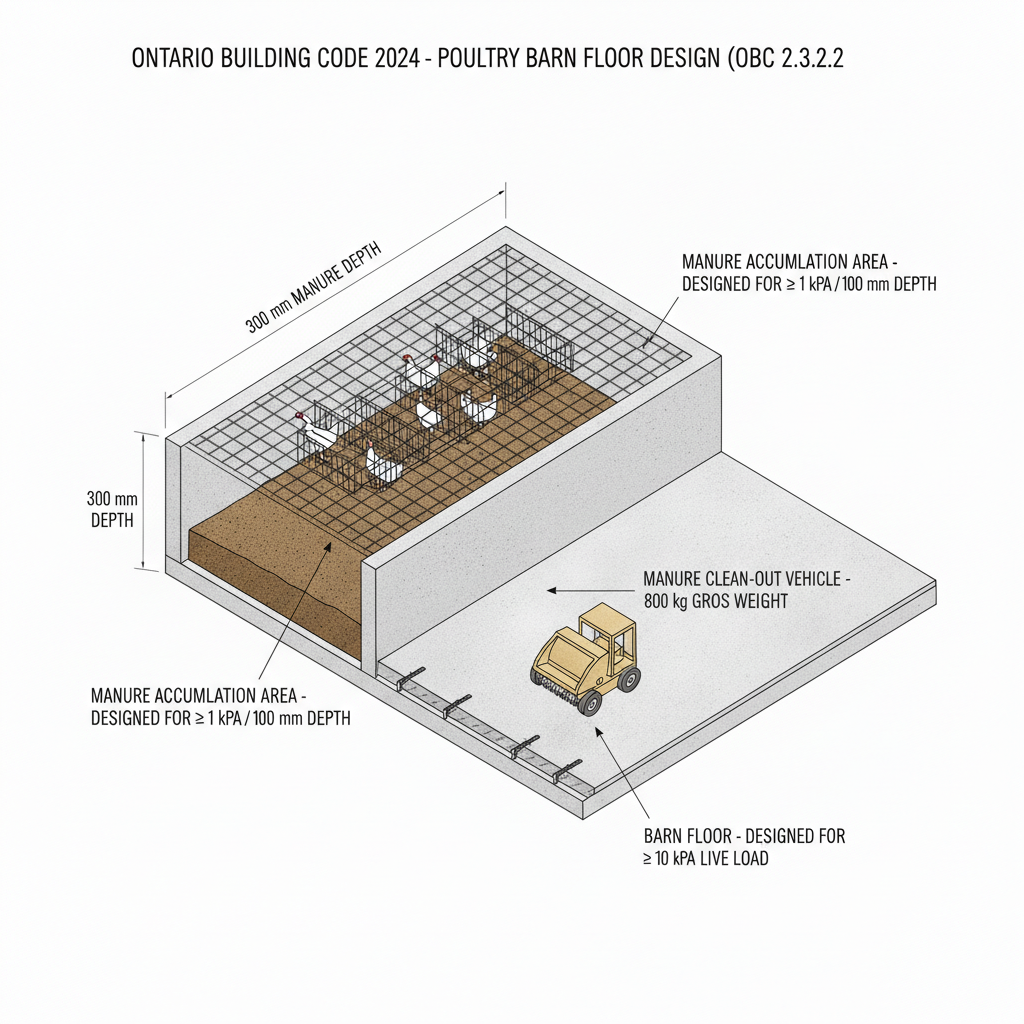
Agricultural floors must be engineered to withstand specific live loads. For poultry manure accumulation, the code requires a design load of at least 1 kPa for every 100 mm of manure depth. Additionally, if clean-out machinery (up to 1,000 kg) is used, floors must support an extra two-wheel live load of 6 kN.
For floors supporting general stored products, the minimum design live load is 5 kPa, though this must be adjusted higher based on the intended occupancy and product density.
Section 2.3.2.4: Farm Machinery and Vehicle Loading
Floor designs for farm vehicles are categorized by gross weight tiers:
- Under 4,000 kg: Minimum 2.4 kPa.
- 4,000 kg to 9,000 kg: Minimum 6 kPa.
- Over 9,000 kg: Minimum 12 kPa.
Crucially, where areas are used for processing, loading, or unloading, these minimum loads must be increased by 50% to account for dynamic stresses and concentrations.
Section 2.3.2.5: Liquid Manure Storage Tank Specifications
Storage tanks for liquid manure require specialized materials to prevent environmental contamination and structural failure. The code mandates the use of steel, reinforced concrete, or prestressed concrete. Specifically, concrete used in these tanks must meet three strict criteria:
- Utilize HS (High Sulfate-resistant) or HSb cement.
- Reach a 28-day compressive strength of at least 32 MPa.
- Maintain a water-to-cement ratio of no more than 0.45.
Tanks must also be designed to handle internal lateral pressure (10 kN/m³), internal ice pressure, and external earth/surcharge loads if located near vehicular traffic.
Disclaimer: This content is generated from the Ontario Building Code for educational purposes. Always consult with a licensed professional engineer or your local building department before starting any construction project in London, Ontario.