OBC 2024 Firestop Requirements: Essential Guide for Fire Separations in Ontario
Sarah's Expert Insight
OBC Compliance Specialist
"In high-growth areas like London and Oakville, the distinction between 'F' and 'FT' ratings in horizontal fire separations is a frequent point of failure during municipal inspections. At empcontracting.ca Inc. your construction contractor in London, Ontario, we ensure that every penetration—from HVAC ducting to plumbing—is sealed with verified CAN/ULC-S115 systems to protect both your investment and occupant safety."
Understanding the 2024 Ontario Building Code (OBC) is critical for ensuring the structural integrity and fire safety of any commercial or residential build. Section 3.1.9.1. specifically addresses the rigorous standards for penetrations in fire-rated assemblies, ensuring that fire separations remain effective even when pierced by service equipment.
Understanding Firestop Standards (CAN/ULC-S115)
According to the OBC, any penetration of a fire separation or membrane must be sealed by a firestop system. These systems must be tested under the CAN/ULC-S115 standard, "Standard Method of Fire Tests of Firestop Systems." The code distinguishes between two primary types of ratings:
- F Rating: Required for most fire separations, ensuring the firestop resists the passage of flame.
- FT Rating: Required for firewalls and horizontal fire separations, providing both a flame barrier and thermal insulation to prevent heat transfer.
Cast-in-Place and Material Exceptions
Article 3.1.9.1.(1)(b) allows for certain penetrations to be sealed without a specific firestop system if they are cast-in-place. This applies to non-combustible materials such as steel, ferrous metals, copper, concrete, or masonry. This is a common practice in modern concrete high-rise developments in cities like London and Oakville.
Special Requirements for Occupancies and Exits
The code identifies high-risk areas where firestop integrity is non-negotiable. This includes:
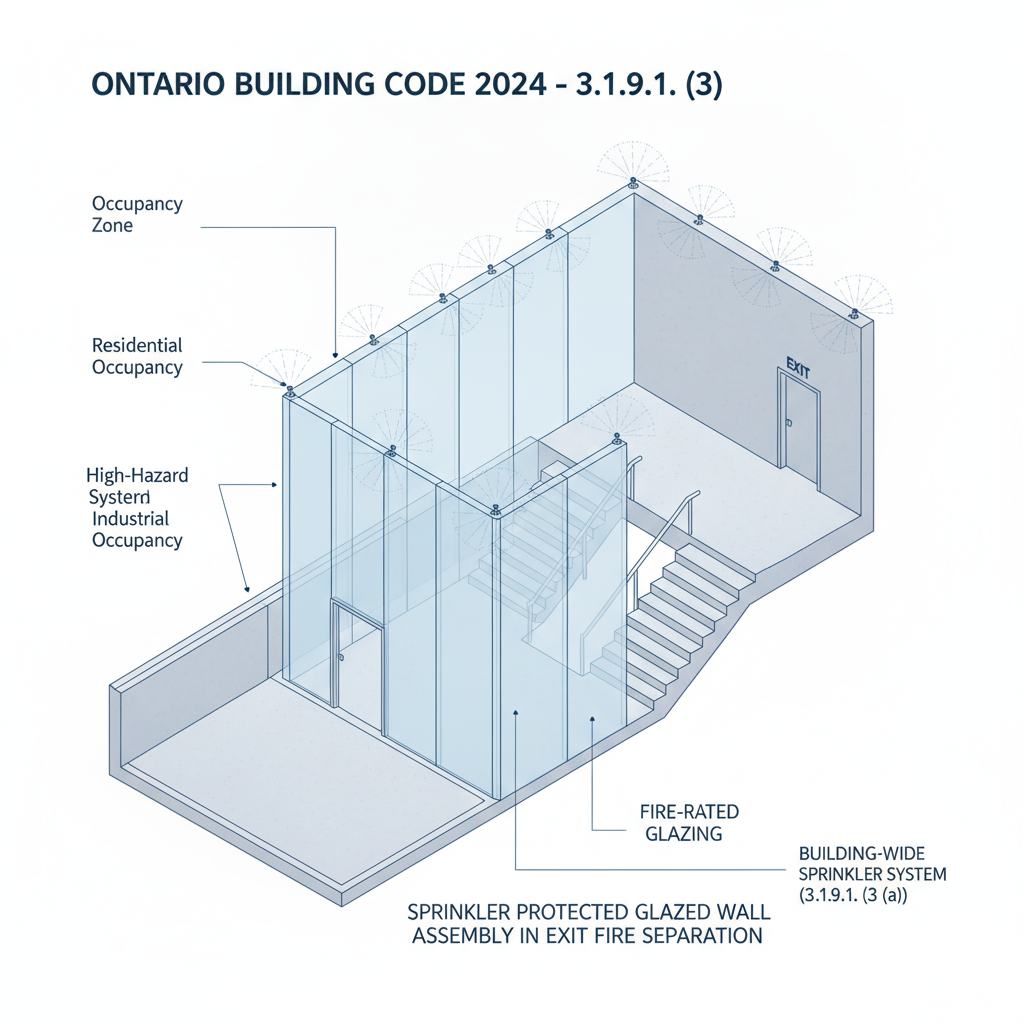
High-Hazard and Residential Occupancies
Stringent rules apply to high-hazard industrial buildings and residential occupancies. If a sprinkler-protected glazed wall assembly is used in an exit fire separation, the entire building must be sprinklered, and these assemblies cannot account for more than half of the required exits.
Sprinklers and Fire Dampers
Not all penetrations require a CAN/ULC-S115 firestop. For instance, sprinklers may penetrate a fire separation provided they are fitted with a metal escutcheon plate in accordance with NFPA 13. Similarly, fire dampers must be installed in conformance with NFPA 80 to maintain the assembly's rating without a dedicated firestop system.
For expert navigation of these complex codes, trust empcontracting.ca Inc. your construction contractor in London, Ontario to deliver compliant, safe, and professional results.
Disclaimer: This content is generated from the Ontario Building Code for educational purposes. Always consult with a licensed professional engineer or your local building department before starting any construction project in London, Ontario.