Ontario Building Code Firewalls: Mastering OBC 3.1.10 for Structural Safety and Compliance
Sarah's Expert Insight
OBC Compliance Specialist
"In the growing industrial hubs of London and the commercial corridors of Oakville, strictly adhering to OBC 3.1.10 is the difference between a localized incident and a total loss of property. At empcontracting.ca Inc., we find that the shift toward 2-hour non-masonry alternatives requires meticulous attention to moisture and damage protection, making professional oversight essential for long-term structural durability in Ontario's climate."
Understanding the complexities of the Ontario Building Code (OBC) regarding firewalls is essential for any major commercial or industrial development. Sections 3.1.10.1 and 3.1.10.2 detail the rigorous standards required to ensure that firewalls remain functional even when adjacent structures fail.
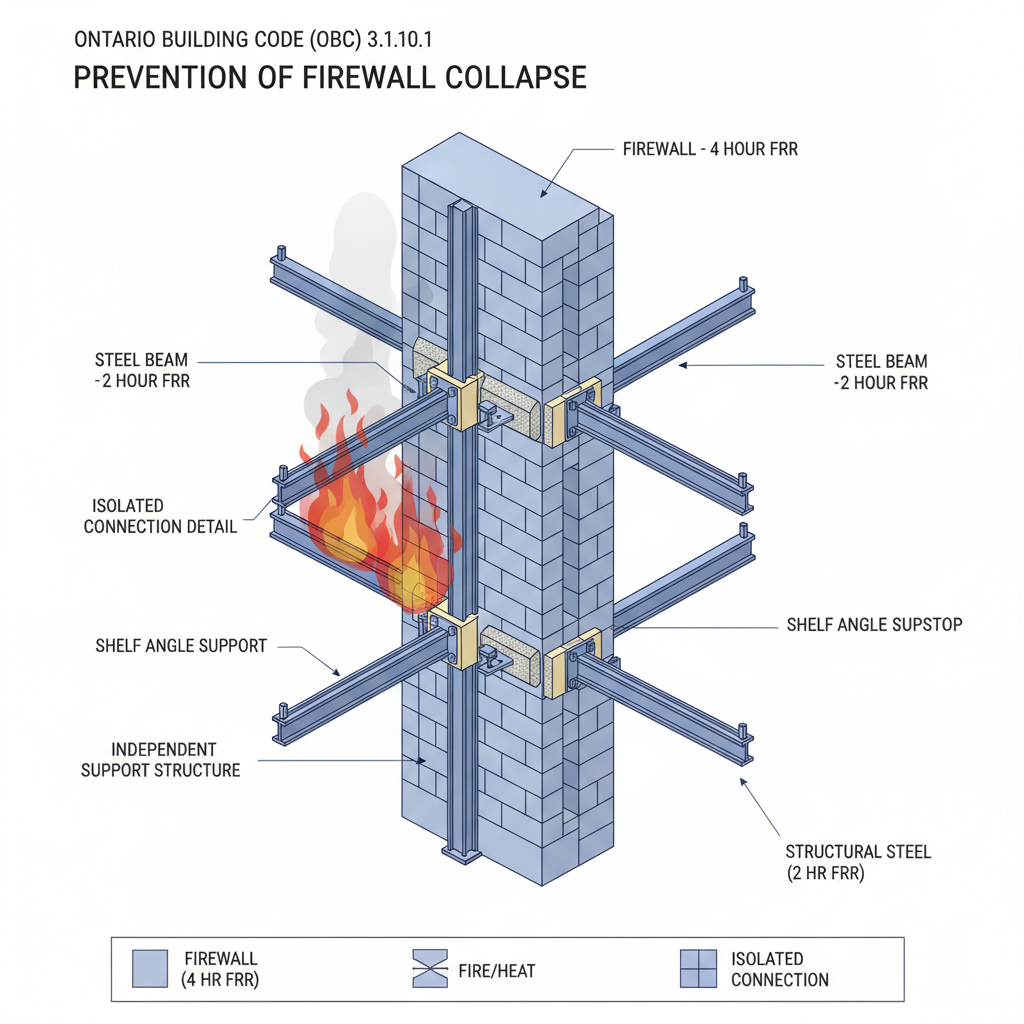
OBC 3.1.10.1: Prevention of Firewall Collapse
The primary goal of a firewall is to remain standing even if the structure on one side collapses due to fire damage. This section mandates that connections and supports for structural framing must be designed so that the failure of the framing system will not compromise the firewall's integrity.
Structural Framing and Supports
According to the 2024 Building Code Compendium, there are two main ways to achieve this:
- Independent Integrity: Structural members must be designed to break away or be supported such that their collapse does not pull the firewall down.
- Double Wall Assemblies: A firewall may consist of two separate wall assemblies, each tied to its own building frame. If one side collapses, the other remains as a fire separation.
- Noncombustible Support: Firewalls can be supported by the structural frame of a noncombustible building, provided that the frame itself has a fire-resistance rating equal to or greater than the firewall.
Integration of Services
It is not just the frame that matters; piping, ducts, and noncombustible raceways must also be installed so that their potential collapse during a fire does not threaten the stability of the firewall.
OBC 3.1.10.2: Fire-Resistance Ratings for Firewalls
The rating of a firewall depends heavily on the occupancy type of the buildings it separates. Proper classification is key to compliance.
High-Hazard Occupancies (Groups E and F)
For buildings containing Group E (Retail) or Group F, Division 1 or 2 (Industrial/High Hazard) occupancies, the firewall must generally be a fire separation of noncombustible construction with a rating of at least 4 hours. There are exceptions for the upper portions of these walls if they separate less hazardous occupancy types.
Standard Occupancies
For most other major occupancy types, a 2-hour fire-resistance rating is required. While masonry and concrete are the standard materials for achieving these ratings, the code does allow for alternative assemblies under specific conditions.
Masonry vs. Alternative Assemblies
While Sentence (3) specifies masonry or concrete, Sentence (4) allows for alternatives in 2-hour rated walls provided they meet strict criteria regarding:
- Mechanical damage resistance during normal building use.
- Moisture resistance.
- Performance under fire conditions equivalent to masonry.
- Presence of automatic sprinkler systems in the affected buildings.
For expert guidance on implementing these complex safety standards, trust empcontracting.ca Inc. your construction contractor in London, Ontario to manage your project with precision and local expertise.
Disclaimer: This content is generated from the Ontario Building Code for educational purposes. Always consult with a licensed professional engineer or your local building department before starting any construction project in London, Ontario.