2024 Ontario Building Code for Group C Residential: Expert Guide for Construction in London, Ontario
Sarah's Expert Insight
OBC Compliance Specialist
"The 2024 updates to Mass Timber regulations are a game-changer for urban density in London and Oakville, allowing for more sustainable 12-storey residential builds. At empcontracting.ca Inc., we emphasize that while these codes offer flexibility, the transition between 1-hour and 2-hour ratings in mixed-use structures requires meticulous inspection to avoid costly delays during the framing stage."
Navigating the 2024 Building Code Compendium is essential for developers and homeowners alike. When planning your next multi-residential or high-rise project, empcontracting.ca Inc. your construction contractor in London, Ontario, provides the technical expertise required to ensure full compliance with the latest fire safety and structural standards.
Section 3.2.2.47: Fire-Resistance in Multi-Storey Dwelling Units
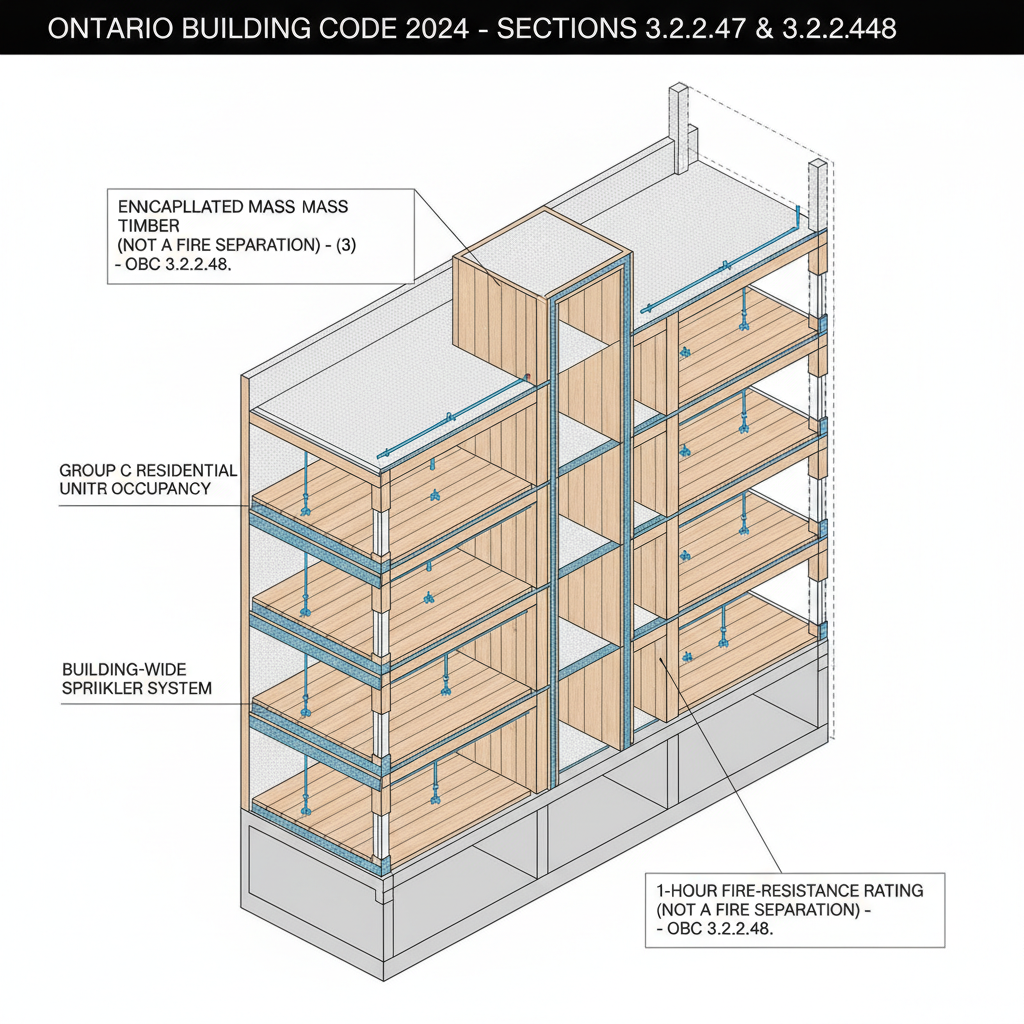
For residential buildings containing dwelling units that span more than one storey, the Ontario Building Code (OBC) mandates that internal floor assemblies, including those over basements, must maintain a fire-resistance rating of at least 1 hour. While these do not necessarily need to be constructed as formal fire separations, they are critical for the internal containment of fire within a single unit.
Section 3.2.2.48: Encapsulated Mass Timber Construction (Up to 12 Storeys)
The OBC now provides clear pathways for Group C buildings to utilize Encapsulated Mass Timber Construction (EMTC) up to 12 storeys. To qualify, the building must meet the following criteria:
- Must be sprinklered throughout.
- Maximum building height of 42 meters and a building area not exceeding 6,000 m².
- Floor assemblies must act as fire separations with a minimum 2-hour fire-resistance rating.
- Loadbearing walls and columns must match the fire-resistance rating of the supported assembly.
Mixed-Use Provisions in High-Rise Structures
Section 3.2.2.48 also allows for mixed-use occupancies (Group A or Group E) within these residential structures, provided they are located on lower levels (e.g., Group E retail below the third storey) to ensure optimal egress and safety.
Section 3.2.2.49: Noncombustible Mid-Rise Residential (Up to 6 Storeys)
For mid-rise developments up to 6 storeys, noncombustible construction is a standard requirement. These buildings must be sprinklered, and the allowable building area is strictly scaled based on the height—ranging from 12,000 m² for a 3-storey building down to 6,000 m² for a 6-storey building. In these cases, floor assemblies typically require a 1-hour fire-resistance rating.
Disclaimer: This content is generated from the Ontario Building Code for educational purposes. Always consult with a licensed professional engineer or your local building department before starting any construction project in London, Ontario.