2024 Ontario Building Code 3.2.3.7: Fire-Resistance and Exposing Building Face Requirements
Sarah's Expert Insight
OBC Compliance Specialist
"As property density increases in urban centers like London and Oakville, adhering to Section 3.2.3.7 is essential for mitigating fire spread between adjacent structures. My team at empcontracting.ca Inc. ensures that whether you are building a commercial hub or a custom residence in Muskoka, your exterior cladding and opening percentages meet these rigorous safety standards without compromising architectural integrity."
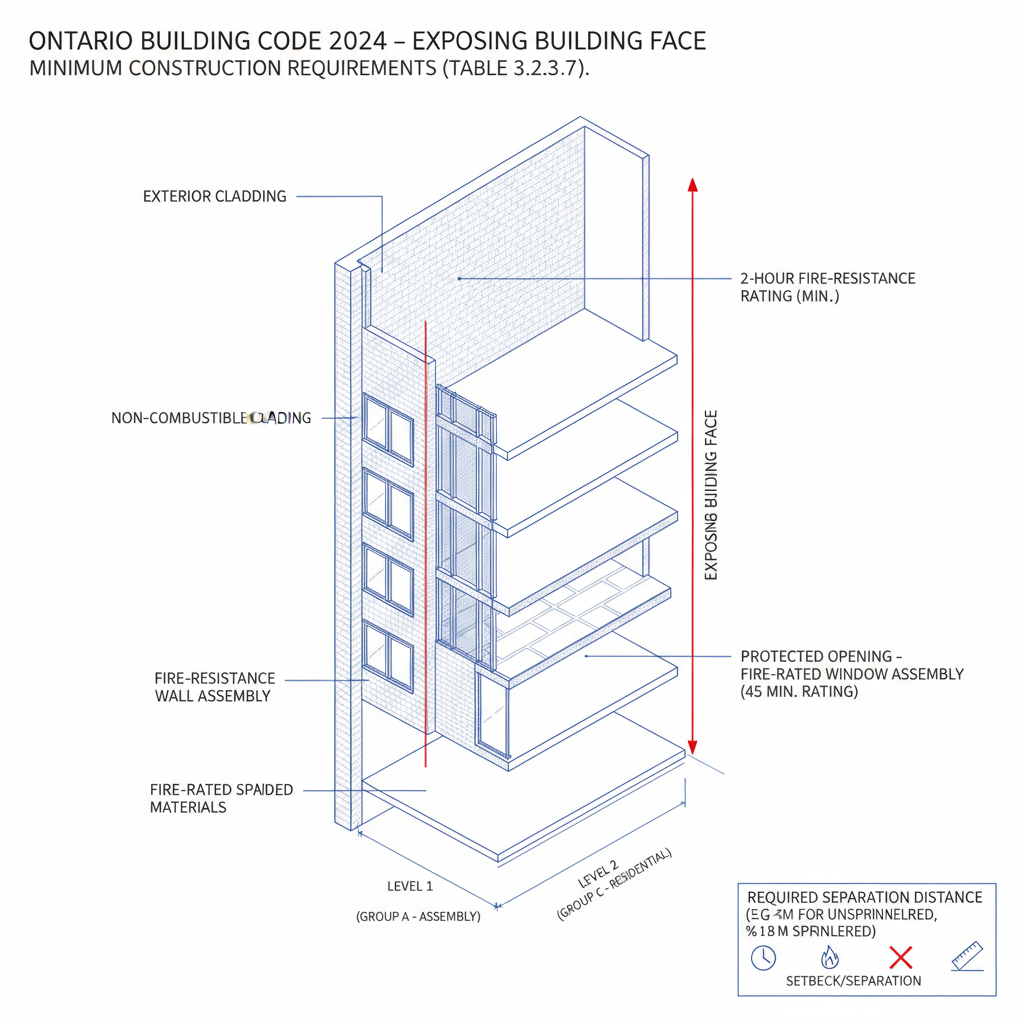
Navigating the complex requirements of the 2024 Ontario Building Code (OBC) is essential for ensuring safety and compliance in modern developments. Section 3.2.3.7 specifically addresses the construction of exposing building faces, dictating how fire-resistance ratings and cladding materials must be applied based on occupancy and proximity to other structures. For expert navigation of these rules, trust empcontracting.ca Inc. your construction contractor in London, Ontario.
Understanding Table 3.2.3.7: Minimum Construction Standards
Article 3.2.3.7 mandates that the fire-resistance rating, construction type, and cladding for exposing building faces must comply with specific safety thresholds. These requirements vary depending on the Occupancy Classification of the building or fire compartment.
Group A, B, C, D, and Group F, Division 3 Occupancies
For these classifications (covering assembly, care, residential, business, and low-hazard industrial), the code sets strict limits:
- 0% to 10% Unprotected Openings: Requires a 1-hour fire-resistance rating with noncombustible construction and cladding.
- >10% to 25% Unprotected Openings: Requires a 1-hour rating; allows combustible, encapsulated mass timber, or noncombustible construction, but requires noncombustible cladding.
- >25% to 50% Unprotected Openings: Requires a 45-minute rating; allows similar construction types with noncombustible cladding.
- >50% to 100% Unprotected Openings: Requires a 45-minute rating; allows both combustible and noncombustible cladding options.
Group E and Group F, Division 1 or 2 Occupancies
Higher-risk occupancies such as mercantile and high-to-medium-hazard industrial buildings require more robust protection:
- 0% to 25% Unprotected Openings: Requires a 2-hour fire-resistance rating and noncombustible cladding.
- >25% to 100% Unprotected Openings: Requires a 1-hour fire-resistance rating, with cladding requirements becoming more flexible as the opening percentage increases.
Exceptions and Waivers for Cladding Requirements
The OBC provides specific conditions under which noncombustible cladding requirements may be waived. Per Sentence (4), requirements for buildings with 25% to 50% unprotected openings may be relaxed if the limiting distance exceeds 5 meters and the building is fully sprinklered. These nuances are why having empcontracting.ca Inc. your construction contractor in London, Ontario on your team is vital for cost-effective and compliant project planning.
Disclaimer: This content is generated from the Ontario Building Code for educational purposes. Always consult with a licensed professional engineer or your local building department before starting any construction project in London, Ontario.