OBC 2024 Guide: Dead-End Corridors and Door Swing Requirements with empcontracting.ca Inc.
Sarah's Expert Insight
OBC Compliance Specialist
"In high-traffic commercial hubs like London and Oakville, proper egress planning is often the difference between a successful inspection and a delayed occupancy permit. At empcontracting.ca Inc., we emphasize that even minor details like door swing direction and dead-end lengths must be integrated into the initial architectural phase to ensure safety in high-occupancy environments across Ontario."
Understanding Ontario Building Code Egress and Corridor Compliance
Ensuring your commercial or industrial facility meets the 2024 Building Code Compendium standards is vital for safety and legal compliance. As empcontracting.ca Inc. your construction contractor in London, Ontario, we specialize in navigating these technical requirements to keep your project on track and your occupants safe.
Dead-End Corridor Limits for Mercantile and Industrial Occupancies
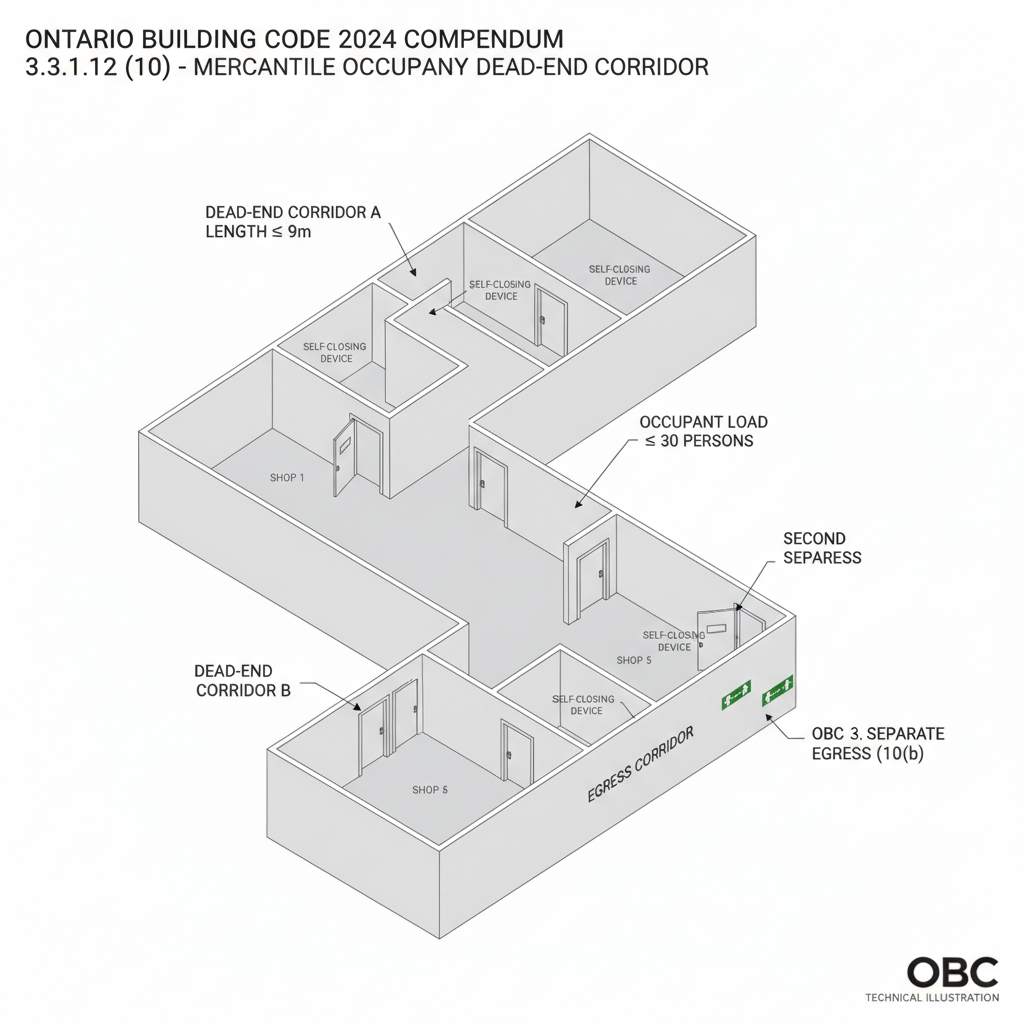
Per OBC Section 3.3.1., dead-end corridors are permitted only under specific conditions to prevent occupants from becoming trapped during an emergency:
- Mercantile and Low/Medium Hazard Industrial: Dead-ends are allowed if they serve fewer than 30 persons, are no longer than 9 meters, and feature self-closing doors. Alternatively, each suite must provide a second, separate egress doorway.
- High-Hazard Industrial: These occupancies have stricter life-safety requirements; a second separate egress doorway must be provided for every room or suite to avoid reliance on a dead-end corridor.
Section 3.3.1.11: Door Swing and Exit Direction
The direction in which a door opens is not just a matter of convenience—it is a critical safety regulation. Doors providing access to an exit must swing on a vertical axis and must swing in the direction of travel if:
- The occupant load exceeds 60 persons.
- The space is a high-hazard industrial occupancy.
- The room is a hazardous classroom in a school or located in a retirement home/care facility.
Furthermore, in corridors requiring travel in both directions, a pair of doors must be installed to swing in opposite directions, ensuring the right-hand door always leads toward the nearest exit.
3.3.1.12. Regulations for Sliding Doors
Modern commercial spaces often utilize sliding doors. However, the OBC requires that these doors be designed to 'break out'—meaning they must swing on a vertical axis in the direction of exit travel when pressure is applied. They must also be clearly labeled with a decal identifying them as swinging doors to ensure functionality during a fire or emergency.
Disclaimer: This content is generated from the Ontario Building Code for educational purposes. Always consult with a licensed professional engineer or your local building department before starting any construction project in London, Ontario.