2024 Ontario Building Code Guide: Hazardous Areas and Compressed Gas Storage Requirements
Sarah's Expert Insight
OBC Compliance Specialist
"Adhering to the 2-hour gas-tight fire separation and explosion venting ratios is a critical safety benchmark for industrial retrofits in London and Oakville. At empcontracting.ca Inc. your construction contractor in London, Ontario, we emphasize that these technical requirements are not just about code compliance, but about ensuring the long-term structural resilience and safety of your facility."
Introduction to OBC 3.3.6 Hazardous Area Design
The 2024 Ontario Building Code (OBC) Compendium, specifically Section 3.3.6, establishes rigorous safety standards for the design and construction of hazardous areas. These regulations are vital for any facility in London or Oakville handling dangerous goods, flammable materials, or highly reactive substances. For professional implementation of these safety standards, trust empcontracting.ca Inc. your construction contractor in London, Ontario.
3.3.6.1. & 3.3.6.2. Application and Storage of Dangerous Goods
This subsection applies to all buildings or parts of buildings intended for the storage, handling, or processing of materials that pose a risk of explosion or high flammability. Key requirements include:
- Fire Separations: Solid and liquid dangerous goods, including oxidizers and organic peroxides, must be separated from the rest of the building by a fire separation with a fire-resistance rating of at least 2 hours.
- Reactive Materials: Must also be isolated by a 2-hour fire-resistance rated separation.
- Explosives: All storage must conform strictly to the federal Explosives Act (Canada).
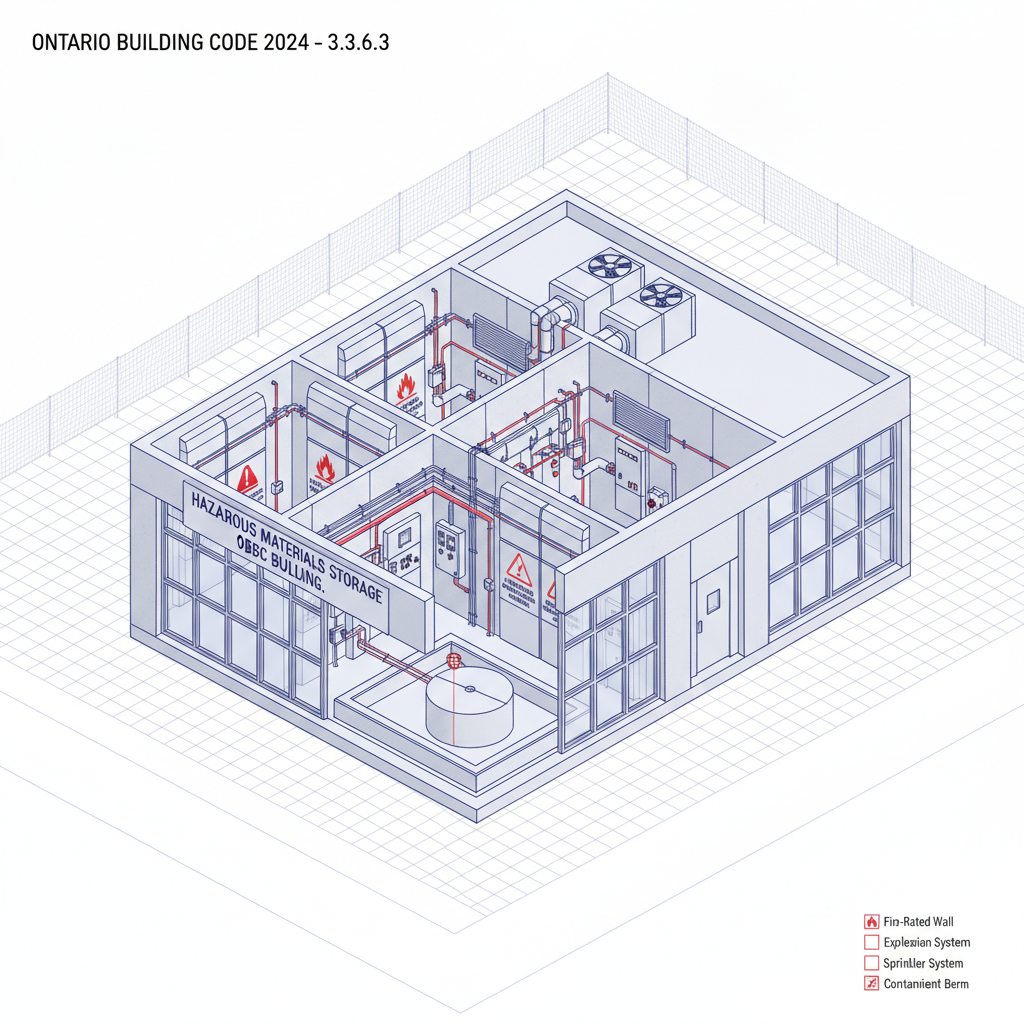
3.3.6.3. Specialized Indoor Storage of Compressed Gases
When storing cylinders of flammable compressed gases, the OBC mandates specific architectural features to prevent catastrophe:
- Gas-Tight Barriers: Storage rooms must be separated from the building by a gas-tight fire separation of no less than 2 hours.
- Exterior Accessibility: The room must be located on an exterior wall and be accessible from the exterior of the building.
- Explosion Venting: Walls must be designed to provide explosion venting, typically in a ratio of 0.2 m² for each cubic metre of room volume, ensuring pressure release in the event of an accident.
- Small Capacity Exceptions: For smaller operations (not more than 3 cylinders), a 45-minute fire separation may be acceptable if located at or above grade and properly ventilated.
Disclaimer: This content is generated from the Ontario Building Code for educational purposes. Always consult with a licensed professional engineer or your local building department before starting any construction project in London, Ontario.