2024 Ontario Building Code Guide: Stair, Guard, and Ramp Standards for London Construction
Sarah's Expert Insight
OBC Compliance Specialist
"The 2024 OBC updates regarding non-climbable guards and strict riser tolerances are frequently flagged during inspections in London and Oakville. At empcontracting.ca Inc. your construction contractor in London, Ontario, we prioritize these precision measurements during the framing stage to prevent costly retrofits, especially in custom Muskoka builds where aesthetic glass guards must still meet the 100mm opening rule."
Navigating the complexities of the 2024 Ontario Building Code (OBC) is essential for ensuring safety and compliance in any construction project. Specifically, Sections 3.4.6.7 and 3.4.6.8 dictate the precise measurements required for ramps, treads, risers, and protective guards.
Guard Safety and Opening Requirements
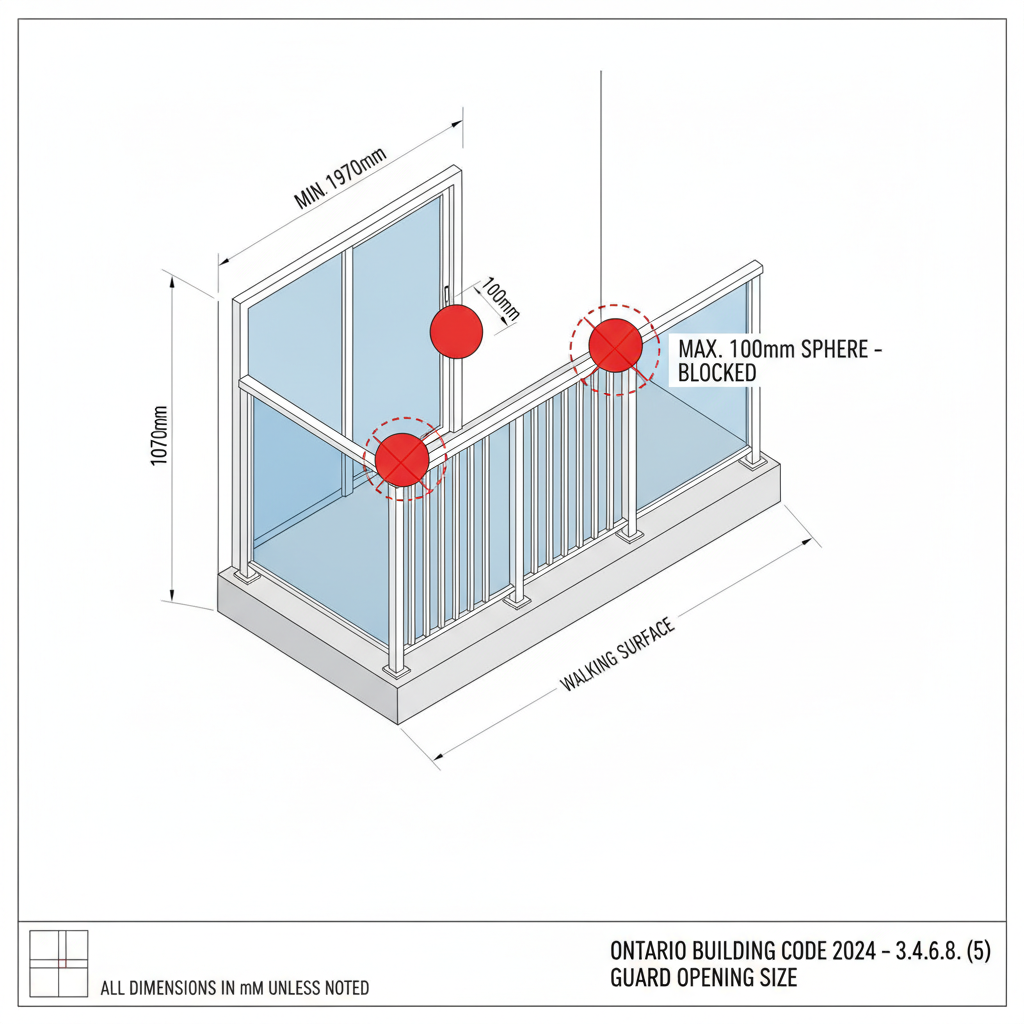
Under the current code, guards must be designed to prevent the passage of a sphere with a diameter greater than 100 mm. This is a critical safety measure to protect children. In industrial settings, this requirement is adjusted to a 200 mm sphere. Furthermore, windows located near stairways must be properly protected or fixed to resist lateral loads if they fall below specific height thresholds.
The Non-Climbable Mandate
Between 140 mm and 900 mm above a floor level, guards must not have any members or attachments that facilitate climbing. As empcontracting.ca Inc. your construction contractor in London, Ontario, we ensure that every railing and guardrail installation adheres to these 'anti-climb' regulations to pass rigorous municipal inspections.
Ramp Slope Specifications (OBC 3.4.6.7)
Ramps must maintain a uniform slope to ensure safe transit. The standard maximum slope is 1 in 12. However, the OBC allows for steeper slopes in industrial occupancies, permitting 1 in 6 for interior ramps and 1 in 10 for exterior ramps, provided they meet industrial safety criteria.
Tread and Riser Precision (OBC 3.4.6.8)
Stair construction requires extreme precision to prevent tripping hazards. The OBC specifies that steps must have a run between 280 mm and 355 mm, and a rise between 125 mm and 180 mm. Consistency is key, as the code mandates strict tolerances for uniformity.
Strict Uniformity Tolerances
The maximum allowable tolerance between adjacent treads or risers is just 5 mm. Across an entire flight of stairs, the difference between the tallest and shortest riser—or the deepest and shallowest tread—cannot exceed 10 mm. Maintaining this level of accuracy is a hallmark of professional contracting.
Disclaimer: This content is generated from the Ontario Building Code for educational purposes. Always consult with a licensed professional engineer or your local building department before starting any construction project in London, Ontario.