2024 Ontario Building Code: Rapid Transit Station Safety and Egress Standards
Sarah's Expert Insight
OBC Compliance Specialist
"In high-density regions like London and Oakville, the interaction between transit hubs and adjacent commercial buildings requires precise smoke migration control and surge-based egress planning. As your construction contractor in London, Ontario, empcontracting.ca Inc. emphasizes that failing to account for the 'missed headway' factor (2.0 multiplier) can lead to significant compliance delays during the provincial safety review process."
Navigating the complexities of the 2024 Ontario Building Code (OBC) is critical for large-scale infrastructure and transit-connected developments. At empcontracting.ca Inc., your construction contractor in London, Ontario, we ensure that every technical requirement—from vestibule smoke protection to peak hour occupant loads—is meticulously implemented.
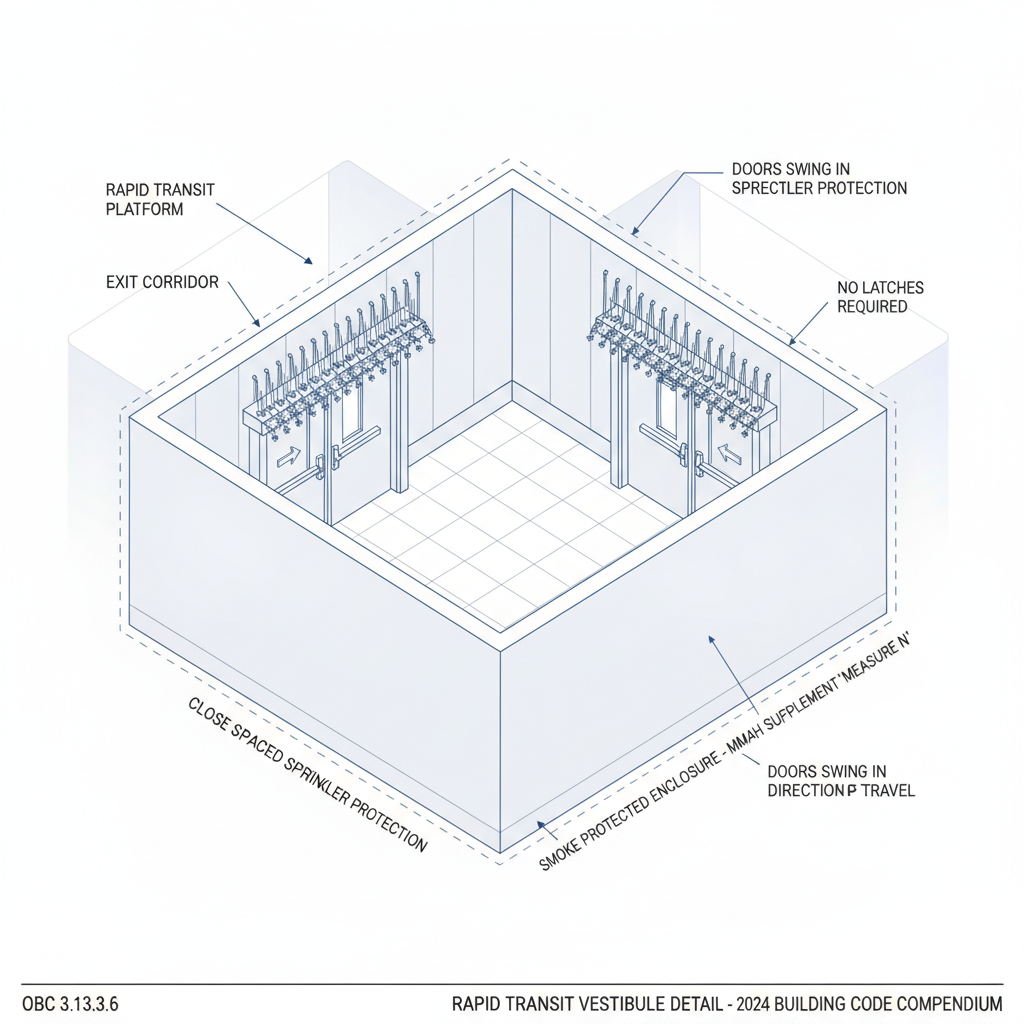
3.13.3.6. Vestibule Design and Smoke Protection
Under Section 3.13.3.6, vestibules serving rapid transit stations must adhere to rigorous fire safety protocols. Doors are required to swing in the direction of travel and must be equipped with close-spaced sprinkler protection on both sides to mitigate fire spread.
Smoke Control and Separation
To ensure public safety, vestibules must not contain any occupancy and must be protected against smoke passage in accordance with MMAH Supplementary Standard SB-4. When stations connect to high-rise or complex buildings, these vestibules serve as a vital life-safety buffer, maintaining separation between the transit facility and the adjacent structure.
3.13.3.7. Emergency Lighting and Power Reliability
In the event of a power failure, rapid transit stations must provide emergency lighting at a minimum level of 10 lx at floor and tread levels. This system must be backed by an emergency power supply capable of maintaining illumination for at least 30 minutes, ensuring safe passage for commuters in high-traffic public areas.
3.13.3.8. Guard Requirements on Platforms
The OBC provides specific exemptions for transit environments; notably, guards are not required at the guideway side of a platform in a rapid transit station, allowing for unobstructed boarding and alighting processes while other safety measures remain in effect.
3.13.4. Means of Egress and Occupant Load Calculations
Determining the occupant load for transit stations is a sophisticated process based on peak hour patronage. As empcontracting.ca Inc. advises its clients, these calculations must account for:
- Entraining Loads: Passengers waiting for transport, multiplied by a 1.3 surge factor.
- Link Loads: The volume of passengers traveling through the station.
- Missed Headway: A factor of 2 must be applied in peak directions to account for potential service delays and increased platform density.
Whether you are developing near transit hubs in London, Oakville, or Muskoka, understanding these egress requirements is essential for a compliant and safe build.
Disclaimer: This content is generated from the Ontario Building Code for educational purposes. Always consult with a licensed professional engineer or your local building department before starting any construction project in London, Ontario.