Understanding OBC 2024: Change of Use and Temporary Structures with empcontracting.ca Inc.
Sarah's Expert Insight
OBC Compliance Specialist
"Navigating the 2024 OBC updates for 'Change of Use' is critical for property owners in London, Oakville, and Muskoka, as shifting a building's occupancy—such as converting a farm building or expanding a residential suite—can trigger complex structural and fire safety requirements. At empcontracting.ca Inc. your construction contractor in London, Ontario, we emphasize that early compliance planning for demountable structures and occupancy changes prevents costly delays and ensures your project meets the highest safety and accessibility standards."
Compliance Standards for Demountable Stages and Support Structures
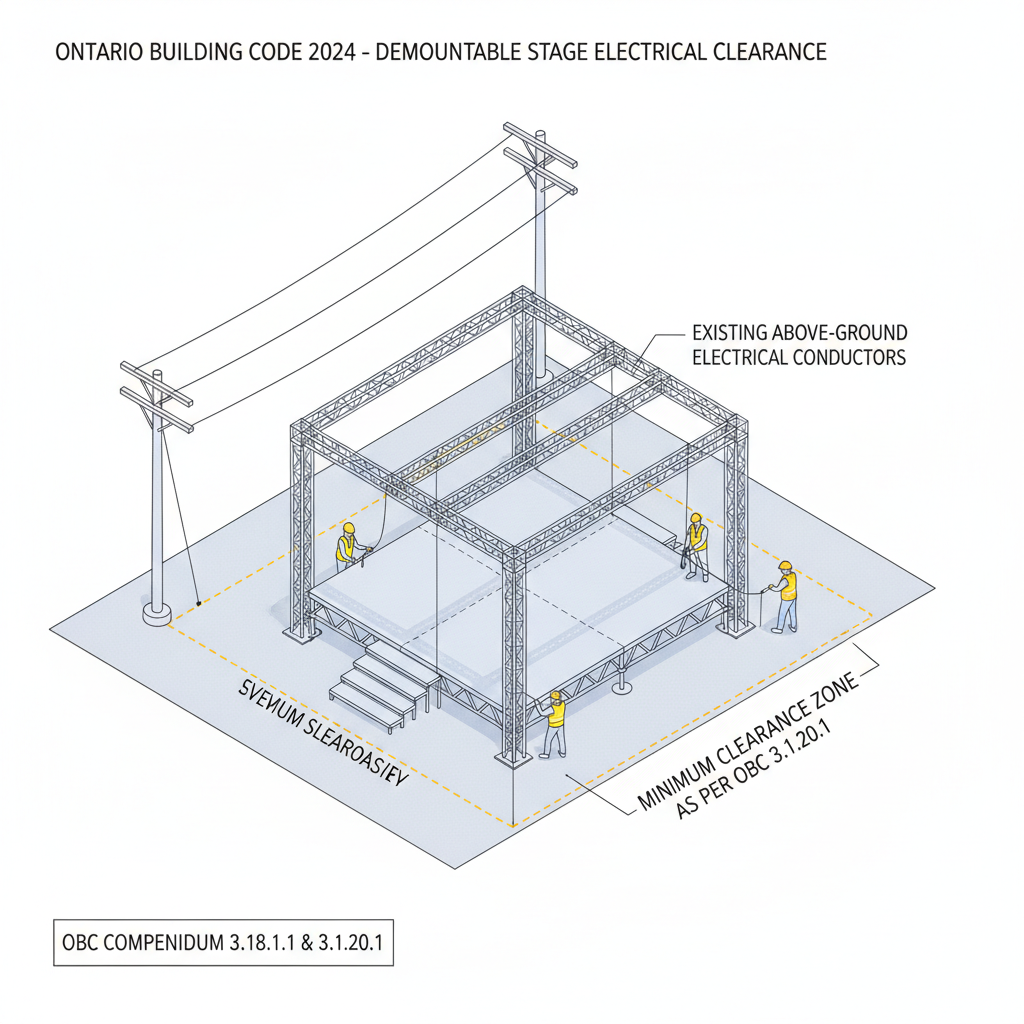
Under the 2024 Ontario Building Code, specific regulations govern the assembly and installation of demountable stages. When these structures are positioned near existing above-ground electrical conductors, they must strictly follow Article 3.1.20.1 to ensure public safety.
Structural Provisions and Engineering Practices
According to Section 3.17.2.8, demountable stages and their structural components must be designed and installed in accordance with Part 4 of the OBC or adhere to recognized engineering practices like ANSI E1.21 for temporary outdoor entertainment structures. Key factors include:
- Wind Loads: Reference velocity pressure must be calculated based on a 1-in-10-year probability with a 2.5 gust factor.
- Importance Category: These structures are assigned a 'Normal Importance Category' per Table 4.1.2.1.
- Foundations: Footings must comply with Clause 9.4.4.1.(1)(b).
Accessibility and Barrier-Free Design
Section 3.17.2.9 mandates that if a demountable stage is intended for limited public occupancy, a barrier-free path of travel must be provided to at least one platform level, ensuring inclusivity in compliance with Articles 3.8.1.3. and 3.8.3.4.
Section 3.18: Additional Requirements for Existing Buildings
The 2024 Building Code Compendium 3.18.1.1 defines when construction triggers additional requirements due to a change of use. This applies to your projects when:
Major Occupancy and Use Changes
- A major occupancy changes to one designated with a 'Y' in Division C.
- Residential (Group C) suites are converted into multiple suites.
- Spaces are converted into gaming premises or retirement homes.
- Farm buildings are transitioned into major occupancy classifications.
- A building is designated as a post-disaster facility.
Vertical Extensions in Combustible Construction
If an existing building of combustible construction is extended by adding storeys that result in a building height exceeding four storeys, the stringent requirements of Section 3.18 are triggered. For expert guidance on these transitions, trust empcontracting.ca Inc. your construction contractor in London, Ontario.
Disclaimer: This content is generated from the Ontario Building Code for educational purposes. Always consult with a licensed professional engineer or your local building department before starting any construction project in London, Ontario.