OBC 4.1.3.2 Strength and Stability Guide | empcontracting.ca Inc. London Ontario
Sarah's Expert Insight
OBC Compliance Specialist
"As a senior consultant at empcontracting.ca Inc. your construction contractor in London, Ontario, I cannot overstate the importance of Article 4.1.3.2 in regional builds. Whether we are managing heavy snow load requirements for a cottage in Muskoka or calculating wind resistance for high-density projects in Oakville, these load combinations are the scientific foundation that prevents structural failure. Precision in factoring dead and live loads ensures that your investment is not just code-compliant, but structurally resilient for decades to come."
In the 2024 Ontario Building Code Compendium, Article 4.1.3.2. dictates the fundamental requirements for the Strength and Stability of structures. At empcontracting.ca Inc. your construction contractor in London, Ontario, we prioritize these calculations to ensure every project exceeds safety standards.
Understanding Factored Resistance (ΦR)
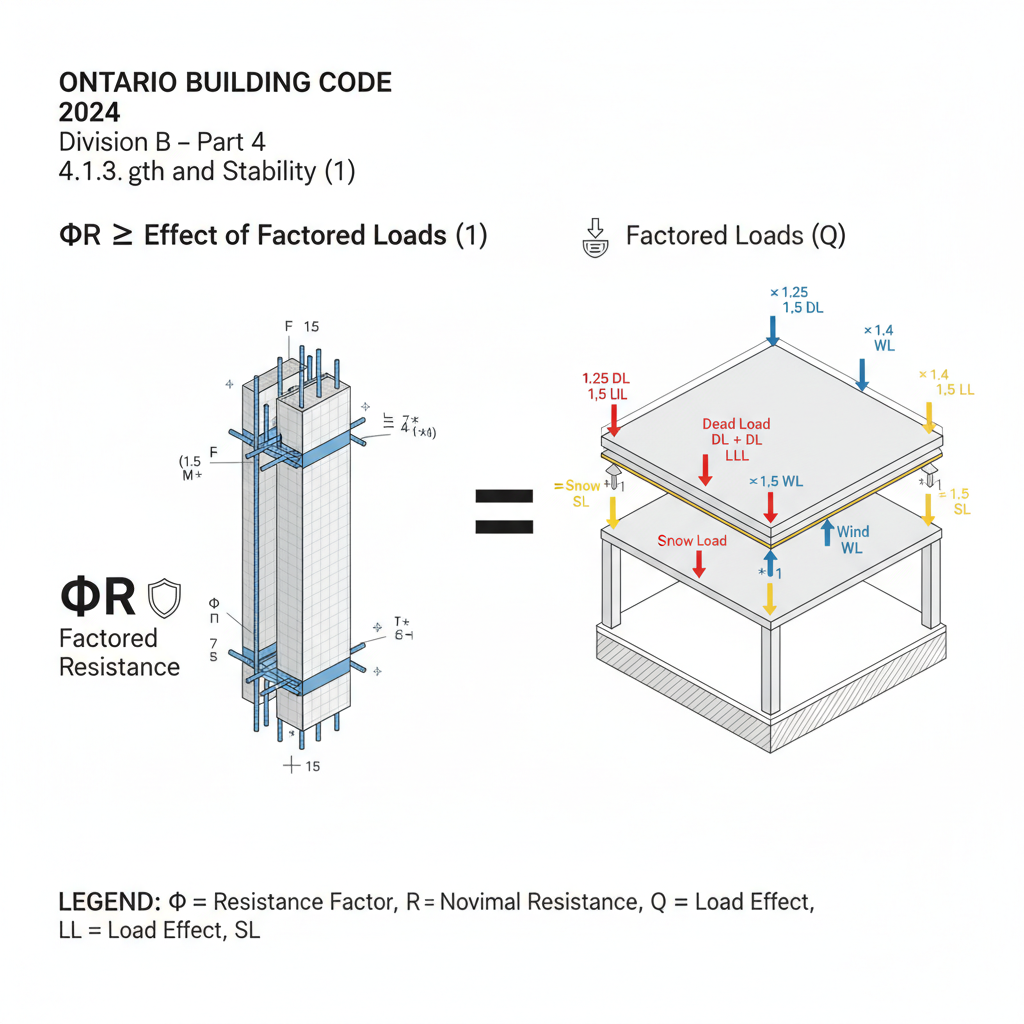
Per Sentence (1), all buildings and structural components must be designed so that their factored resistance (ΦR) is greater than or equal to the effect of factored loads. This ensures that the material strength, modified by safety factors, can withstand the predicted environmental and usage stresses.
Load Combination Cases for Structural Safety
Sentence (2) specifies that factored loads must be determined using specific combinations to find the most critical effect on the structure. These are categorized into:
Ultimate Limit States (Table 4.1.3.2.-A)
- Case 1: Focuses primarily on Dead Loads (1.4D).
- Case 2: Combines Dead Loads with 1.5 Live Loads (L) and companion Snow or Wind loads.
- Case 3: Prioritizes Snow Loads (1.5S) alongside Live and Wind loads.
- Case 4: Factors in Wind Loads (1.4W) as the principal force.
- Case 5: Accounts for Earthquake loads (1.0E) with companion Live and Snow factors.
Environmental and Restraint Factors
Sentence (4) requires that lateral earth pressure (H), pre-stress effects (P), and imposed deformations (T) must be calculated with specific load factors (1.5, 1.0, and 1.25 respectively) whenever they affect the structural safety of the build. This is particularly vital for projects involving complex foundations or retaining walls.
Overturning and Uplift Protection
Sentence (5) addresses the counteracting dead loads used to resist overturning or sliding. When the dead load acts to keep a building stable against wind or seismic uplift, a factor of 0.9D or 1.0D is applied to ensure the design does not over-rely on the weight of the building for stability.
Disclaimer: This content is generated from the Ontario Building Code for educational purposes. Always consult with a licensed professional engineer or your local building department before starting any construction project in London, Ontario.