OBC 2024 Guide: Load Combinations with Crane Loads and Fatigue Standards
Sarah's Expert Insight
OBC Compliance Specialist
"For industrial projects in London or heavy manufacturing facilities in Oakville, the precision of crane load factors under Table 4.1.3.2.-B is the difference between a facility that lasts and one that fails prematurely. As empcontracting.ca Inc. your construction contractor in London, Ontario, we ensure that dynamic analysis for fatigue is integrated early in the design phase to protect your investment against the stresses of cyclical machinery operation."
Understanding Table 4.1.3.2.-B: Load Combinations for Ultimate Limit States
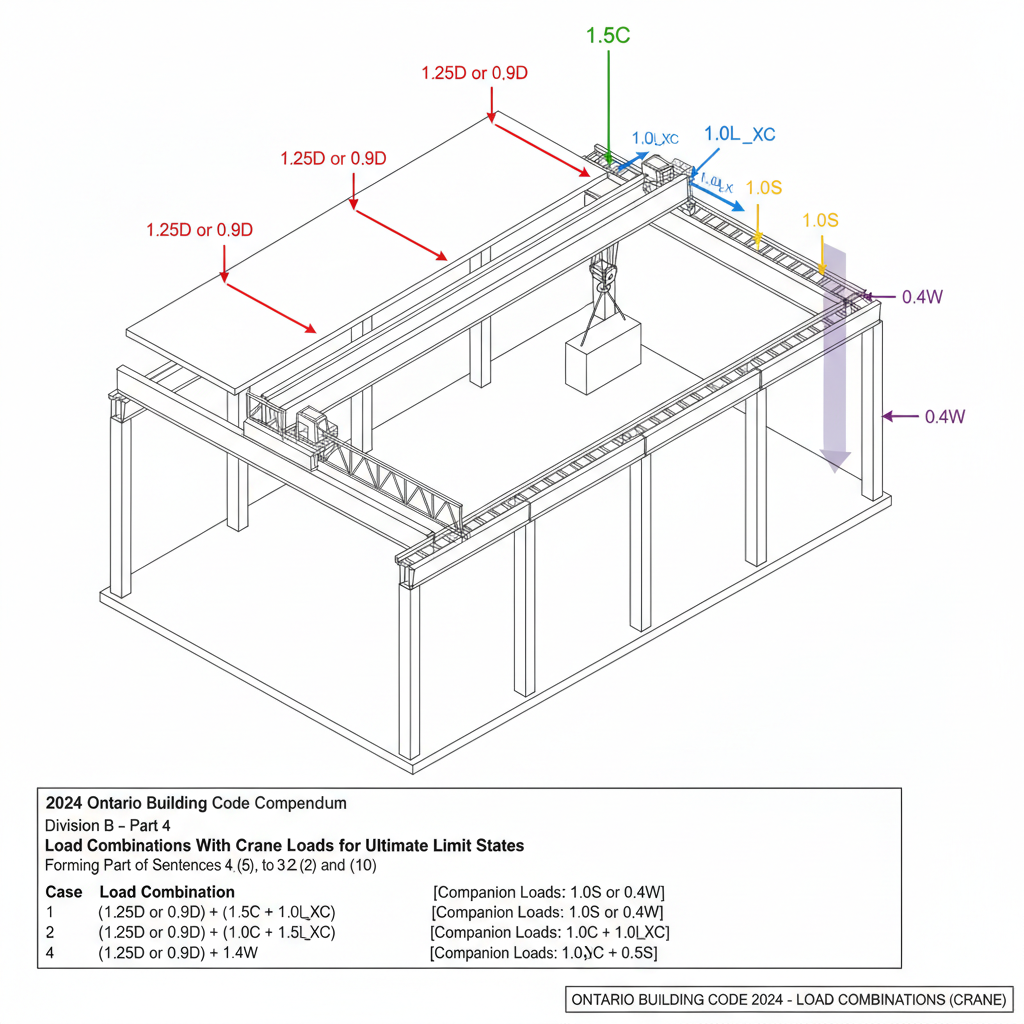
In structural engineering, ensuring the safety of buildings under heavy stress is paramount. The 2024 Ontario Building Code (OBC) provides rigorous standards for load combinations involving crane loads. As empcontracting.ca Inc. your construction contractor in London, Ontario, we prioritize these calculations to ensure every industrial and commercial project meets the Ultimate Limit States (ULS).
Principal and Companion Load Factors
The code identifies six specific cases where crane loads (C) interact with other forces such as Dead Loads (D), Live Loads (L), Snow (S), Wind (W), and Earthquake (E) loads. For example, Case 1 requires a factor of 1.5 for crane loads when combined with specific companion loads, ensuring the structural frame can withstand the dynamic forces of heavy lifting equipment.
Soil and Earth Pressure Adjustments
Specific notes in the OBC clarify that the load factor for dead loads (D) involving soil and plants must be increased to 1.5, with adjustments available for soil depths exceeding 1.2 meters. This is particularly relevant for projects in Ontario that involve subterranean levels or heavy landscaping on structural slabs.
Section 4.1.3.3: Addressing Fatigue and Vibration
Cyclical Load Management
According to Section 4.1.3.3., buildings and their structural components must be checked for fatigue failure. This is critical for connections subject to cyclical loads. If a structure is expected to house machinery that creates significant resonance, a full dynamic analysis is mandatory to prevent structural degradation over time.
Ensuring Lateral and Torsional Stability
The code mandates that provision must be made for the stability of the structure as a whole. This includes lateral, torsional, and local stability. Furthermore, sway effects produced by vertical loads (the P-Delta effect) must be factored into the design of all structural members to ensure the building remains secure under its own weight and applied forces.
Disclaimer: This content is generated from the Ontario Building Code for educational purposes. Always consult with a licensed professional engineer or your local building department before starting any construction project in London, Ontario.