Ontario Building Code 2024: Guide to Partition and Live Loads for Construction in London, Ontario
Sarah's Expert Insight
OBC Compliance Specialist
"In my experience consulting on projects from London to Muskoka, many developers overlook the 1 kPa minimum partition allowance for 'unplanned' spaces, which can lead to structural issues during future office reconfigurations. As empcontracting.ca Inc. your construction contractor in London, Ontario, we ensure these load calculations are rigorously applied from the start, protecting your investment against structural fatigue and ensuring easy occupancy transitions in Oakville and beyond."
Understanding the 2024 Ontario Building Code (OBC) is essential for ensuring the structural integrity of any building project. As you plan your next development, it is vital to account for both dead loads, such as partitions, and live loads based on occupancy to remain compliant with provincial safety standards.
4.1.4.1. Dead Loads: Partition Weight Requirements
Partitions play a significant role in the structural calculations of a building. The OBC specifies how these loads must be documented and factored into your engineering drawings.
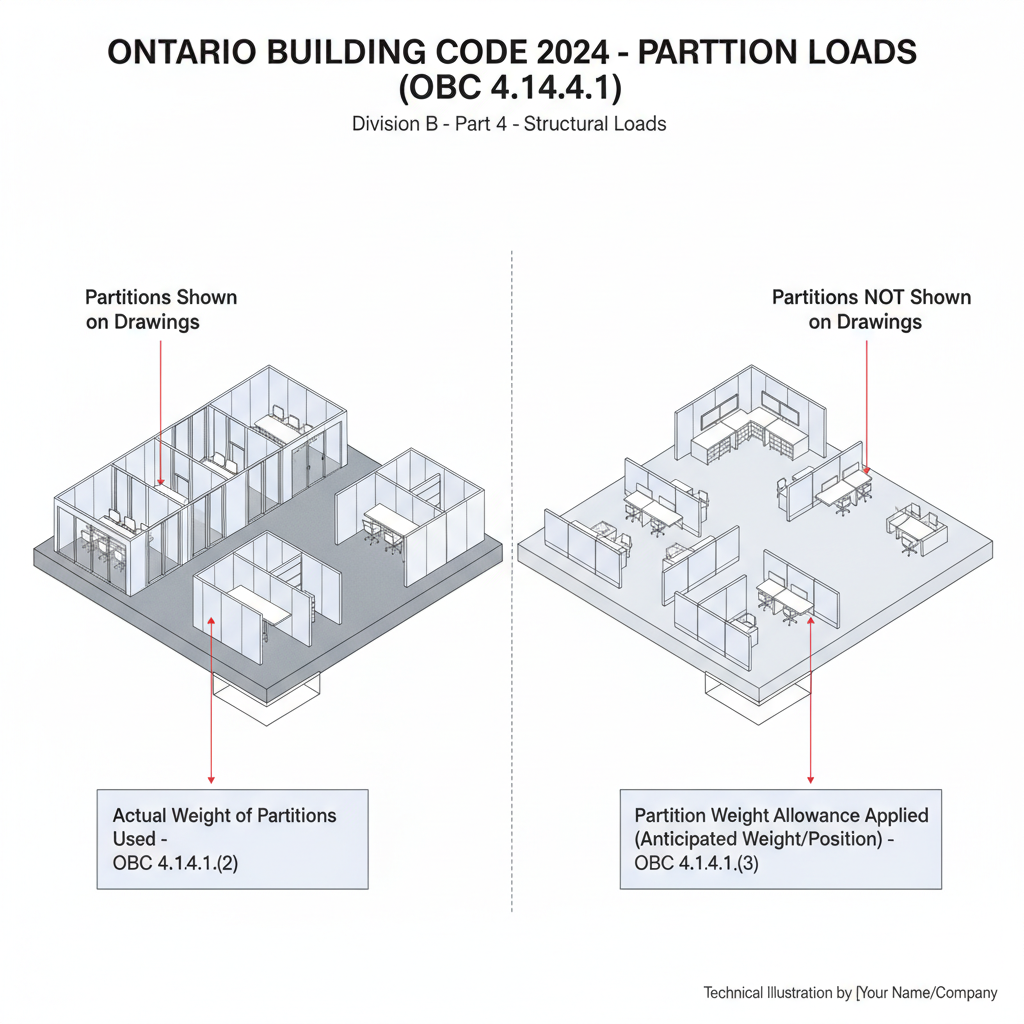
Actual vs. Anticipated Weight
- Designated Partitions: Where partitions are clearly shown on the architectural drawings, their actual weight must be used in calculations.
- Undesignated Partitions: In areas where specific partition locations are not yet determined, a partition weight allowance must be used. This allowance must not be less than 1 kPa over the floor area.
Counteractive Loads
Crucially, the code stipulates that if a partition weight allowance or the dead load of soil/plants is counteractive to other loads (meaning it would theoretically improve stability in a way that might not be permanent), it must not be included in the safety design calculations.
4.1.5. Live Loads Due to Use and Occupancy
Live loads refer to the weights produced by the intended use of the floor or roof, including people, equipment, and furniture.
Minimum Specified Live Loads
According to Article 4.1.5.1., live loads must meet the minimum requirements for uniformly distributed load patterns or concentrated loads, whichever results in the more critical structural effect. For buildings categorized under the "Low Importance Category," a reduction factor of 0.8 may be applied to these loads.
Handling Unspecified Uses
If a specific use for a floor or roof area is not listed in the OBC tables, the live loads must be professionally determined based on the probable assembly of persons, accumulation of equipment, and storage of materials to ensure the structure remains safe under peak conditions.
For expert guidance on navigating these complex structural requirements, trust empcontracting.ca Inc. your construction contractor in London, Ontario to handle your project with precision and compliance.
Disclaimer: This content is generated from the Ontario Building Code for educational purposes. Always consult with a licensed professional engineer or your local building department before starting any construction project in London, Ontario.