OBC 4.1.6.2 Snow Load Requirements: A Guide for Ontario Construction
Sarah's Expert Insight
OBC Compliance Specialist
"Correctly applying OBC 4.1.6.2 is vital for projects in London and Muskoka, where heavy lake-effect snow can stress roof trusses beyond their limits. At empcontracting.ca Inc. your construction contractor in London, Ontario, we prioritize these calculations to ensure that high-importance structures and rural builds are designed with the appropriate safety margins for our unique climate."
Understanding the 2024 Ontario Building Code (OBC) section 4.1.6.2 is essential for structural integrity, particularly for projects managed by empcontracting.ca Inc. your construction contractor in London, Ontario. This section outlines how to calculate snow loads to ensure roofs can withstand the heavy accumulation common in the region.
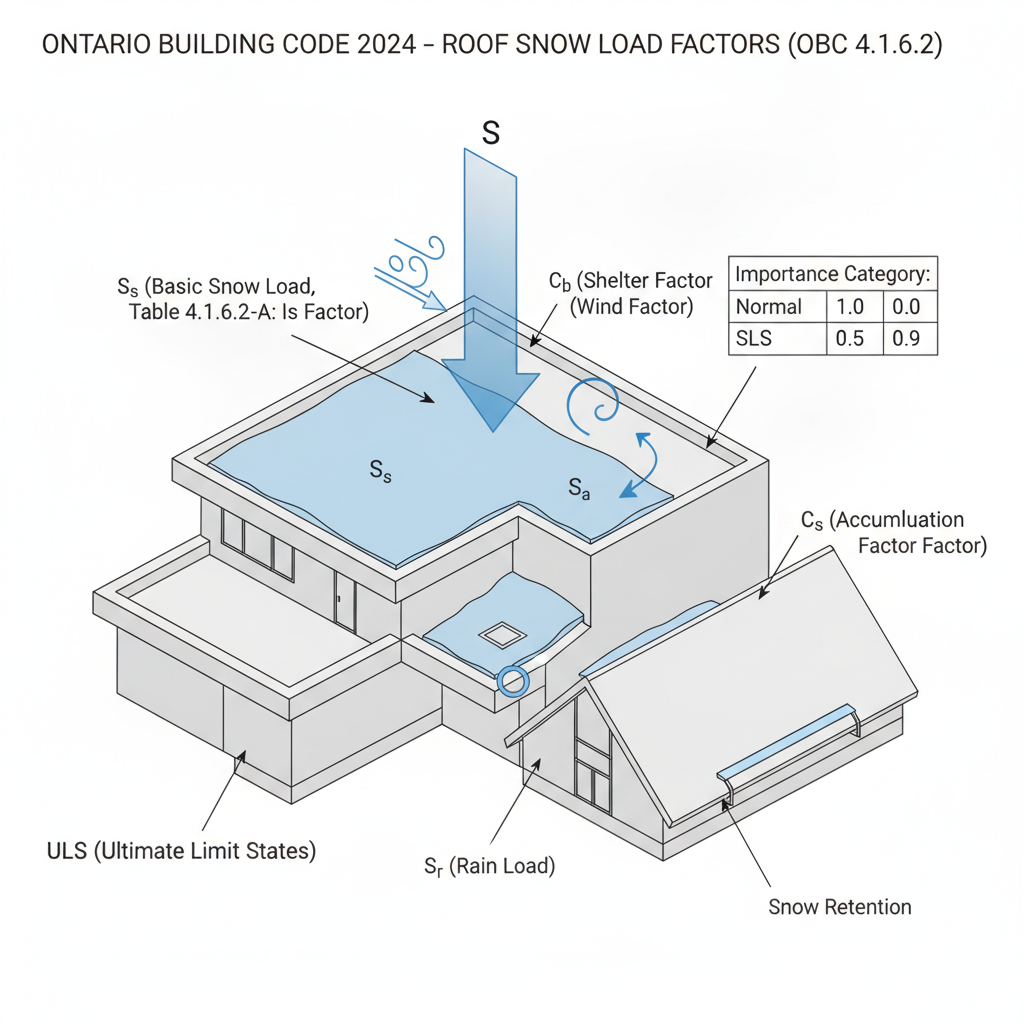
Importance Factor for Snow Load (Is)
The Importance Factor adjusts the design snow load based on the building's use. According to Table 4.1.6.2.-A, structures are categorized into four levels:
- Low: Temporary buildings or low-occupancy structures (ULS 0.8 / SLS 0.9).
- Normal: Standard residential and commercial buildings (ULS 1.0 / SLS 0.9).
- High: Schools and assembly occupancies (ULS 1.15 / SLS 0.9).
- Post-disaster: Hospitals and emergency services (ULS 1.25 / SLS 0.9).
Calculating the Basic Roof Snow Load Factor (Cb)
The factor Cb accounts for the size and shape of the roof. For smaller roofs where the characteristic length (lc) is less than or equal to 70 divided by the square of the wind exposure factor, Cb is typically 0.8. For larger surfaces, a more complex exponential formula is applied to account for increased snow accumulation risks.
Wind Exposure Factor (Cw)
By default, the wind exposure factor is 1.0. However, for Normal Importance buildings in rural areas, this can be reduced to 0.75, provided the building is exposed on all sides and no significant obstructions exist on the roof that would cause drifting. This is a critical consideration for rural properties in the London and Muskoka areas.
The Slope Factor (Cs)
Roof pitch significantly impacts snow retention. The OBC specifies:
- Cs = 1.0: For slopes ≤ 30°.
- Cs = (70° - α)/40°: For slopes between 30° and 70°.
- Cs = 0: For steep slopes exceeding 70°, as snow is expected to slide off.
Consulting with empcontracting.ca Inc. your construction contractor in London, Ontario ensures these variables are calculated with precision for your next build.
Disclaimer: This content is generated from the Ontario Building Code for educational purposes. Always consult with a licensed professional engineer or your local building department before starting any construction project in London, Ontario.