OBC 2024 Snow and Rain Load Guidelines: Expert Insights from empcontracting.ca Inc. your construction contractor in London, Ontario
Sarah's Expert Insight
OBC Compliance Specialist
"In regions like London and Muskoka, accounting for snow drifting on multi-level roofs is non-negotiable due to our high annual precipitation and variable wind patterns. At empcontracting.ca Inc. your construction contractor in London, Ontario, we emphasize that proper scupper placement and accumulation factor analysis are the primary defenses against structural failure during extreme Ontario winters."
Understanding the complexities of the 2024 Ontario Building Code (OBC) regarding environmental loads is essential for structural integrity. As empcontracting.ca Inc. your construction contractor in London, Ontario, we ensure every project adheres to these stringent engineering requirements.
Section 4.1.6.2: Snow Accumulation and Non-Uniform Loads
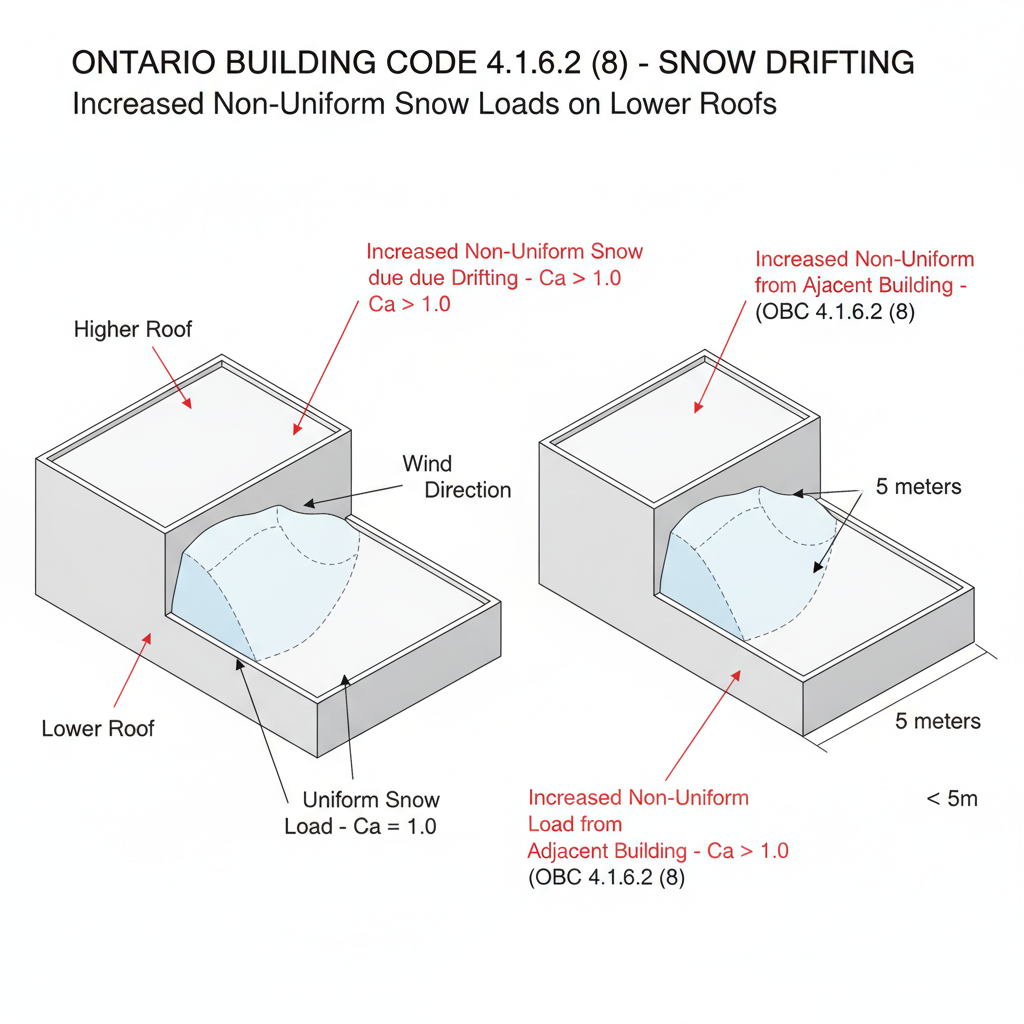
The standard accumulation factor (Ca) is typically 1.0 for uniform snow loads. However, the OBC requires adjustments for specific roof shapes and environmental conditions:
- Snow Drifting: Increased loads on lower roof levels or roofs within 5m of adjacent buildings.
- Roof Projections: Accumulation near penthouses, chimneys, and large equipment.
- Complex Geometries: Non-uniform loads on gable, arch, curved roofs, and domes.
- Secondary Factors: Snow sliding from higher surfaces, valley accumulation, and meltwater drainage.
Special Analysis for Unique Shapes
For roof shapes not explicitly covered, non-uniform snow load cases must be established through field observations, climatic analysis, or model testing to ensure safety.
Section 4.1.6.3: Structural Design for Full and Partial Loading
Structural members must be designed to withstand the most critical effects of snow distribution. For flat, shed, and low-slope gable roofs (15° or less), the code mandates calculations for both full uniform loads and partial loading (where one portion carries full load and the remainder carries half) to identify the most severe structural stress.
Section 4.1.6.4: Specified Rain Load and Drainage Systems
Rain loads are calculated based on the one-day rainfall data for the specific location. Key requirements include:
Secondary Drainage and Scuppers
Where scuppers are used for secondary drainage, the rain load is calculated based on the lesser of the one-day rainfall or a depth of 30mm above the scupper bottom. It is important to note that rain and snow loads generally do not need to be considered simultaneously unless specifically required by Subsection 4.1.6.2.
Section 4.1.6.5: Multi-Level Roof Drifting
For roofs adjacent to higher structures, drifting snow creates a trapezoidal load distribution. This specific accumulation factor is determined by the height differential and the distance from the higher roof (x), ensuring that the transition from drifted snow to uniform snow (Ca = 1.0) is mathematically accounted for in the structural frame design.
Disclaimer: This content is generated from the Ontario Building Code for educational purposes. Always consult with a licensed professional engineer or your local building department before starting any construction project in London, Ontario.