2024 Ontario Building Code Guide: Solar Panel Snow Loads and Wind Load Standards for London Contractors
Sarah's Expert Insight
OBC Compliance Specialist
"In regions like London and Muskoka, where heavy lake-effect snow and high wind gusts are common, strictly adhering to the 2024 OBC's shifted snow load requirements for solar arrays is critical to prevent structural fatigue. At empcontracting.ca Inc. your construction contractor in London, Ontario, we emphasize that the gap height under tilted panels isn't just a design choice—it is a safety factor that determines if your roof can withstand the localized 2.0 Ca load spikes mandated by section 4.1.6.16."
Understanding OBC Section 4.1.6.16: Snow Loads on Solar Panels
As solar installations become more prevalent across Ontario, the 2024 Building Code Compendium has established rigorous standards for calculating snow loads (S) on roofs equipped with solar technology. Whether you are installing parallel or tilted systems, specific coefficients must be applied to ensure structural integrity.
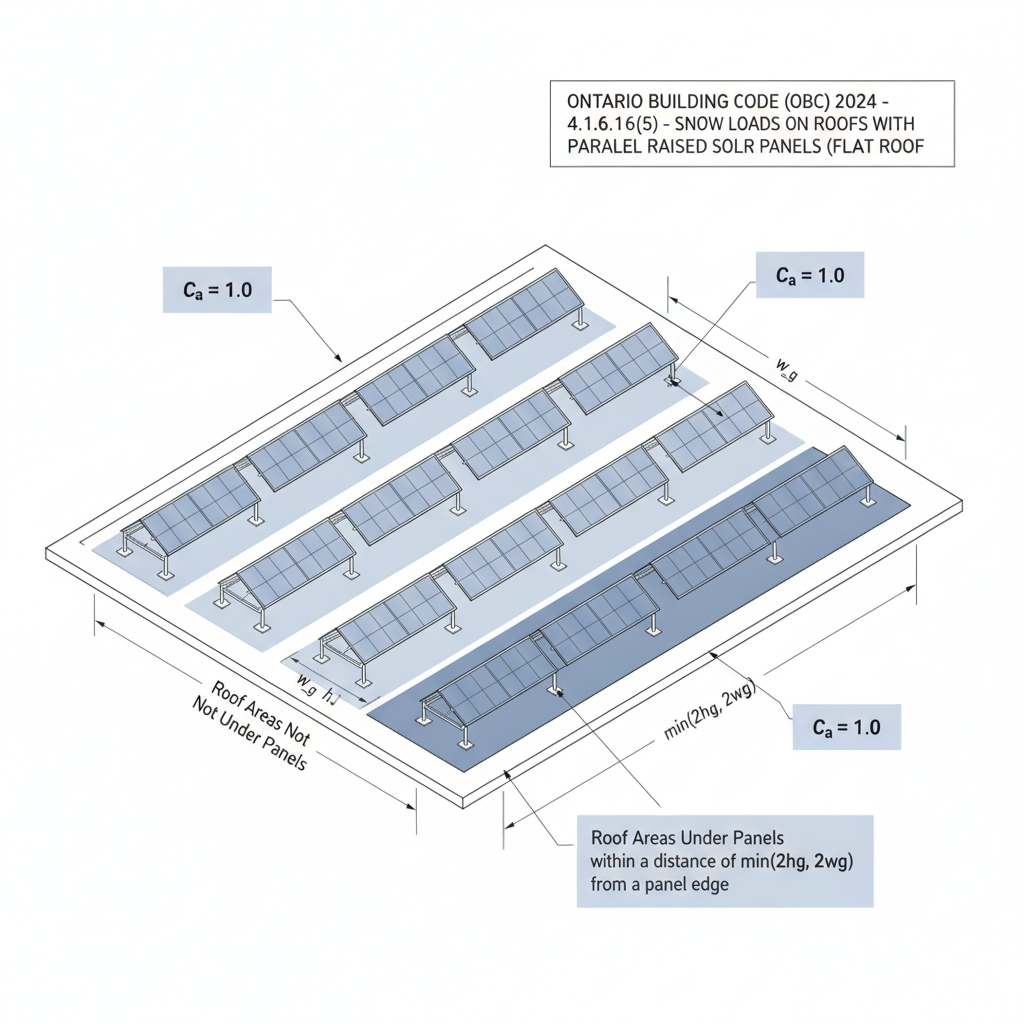
Parallel Raised Solar Panels
For roofs with parallel raised panels, the snow load calculation differs based on roof pitch:
- Flat Roofs: The accumulation factor (Ca) is generally taken as 1.0 for panels and surrounding areas, but may be reduced to 0.0 for specific areas under the panels depending on the gap height (hg) and gap width (wg).
- Sloped Roofs: Calculations must account for snow shifting downslope by a distance equal to the panel width (wp), effectively concentrating the load on lower roof sections.
Tilted Solar Panels on Flat Roofs
Tilted panels create unique aerodynamic and accumulation challenges. The OBC requires specific Ca values ranging from 1.0 to 2.0 based on the gap height (hg) and the height of the highest edge (h). If panels or supports obstruct snow from sliding, the increased volume must be treated as a uniformly distributed load.
Section 4.1.7.1: Specified Wind Load Procedures
Structural safety also depends on how a building handles wind pressure. The 2024 OBC defines three primary procedures for determining specified wind loads:
- Static Procedure: Used for buildings that are not dynamically sensitive.
- Dynamic Procedure: Required for dynamically sensitive structures to account for vibration and gust effects.
- Wind Tunnel Procedure: The gold standard for complex designs or highly sensitive buildings where mathematical models require physical validation.
When planning your next build, ensure your team consults with empcontracting.ca Inc. your construction contractor in London, Ontario, to verify that these complex load calculations are integrated into your structural design.
Disclaimer: This content is generated from the Ontario Building Code for educational purposes. Always consult with a licensed professional engineer or your local building department before starting any construction project in London, Ontario.