OBC 2024 Seismic Design: Mastering Overturning Moments and Torsional Sensitivity in Ontario
Sarah's Expert Insight
OBC Compliance Specialist
"Mastering these seismic nuances is critical for mid-to-high rise structural integrity in Southwestern Ontario, where soil conditions in London and Oakville require precise lateral load analysis. At empcontracting.ca Inc. your construction contractor in London, Ontario, we integrate these complex 2024 OBC standards into every project to ensure long-term stability and safety for our clients in Muskoka and beyond."
Introduction to OBC Section 4.1.8.11: Seismic Calculations
The 2024 Building Code Compendium, specifically Division B – Part 4, outlines rigorous standards for seismic analysis. These regulations ensure that structures throughout Ontario are engineered to withstand lateral forces and complex overturning effects during seismic events.
Fundamental Lateral Periods and Interpolation
For fundamental lateral periods (Ta) exceeding 2.0 or 4.0 seconds, the code mandates specific interpolation methods. These values are crucial for determining the seismic response of taller or more flexible structures, ensuring that the lateral force calculations remain accurate for high-rise developments.
Defining Coupled Walls and Overturning Resistance
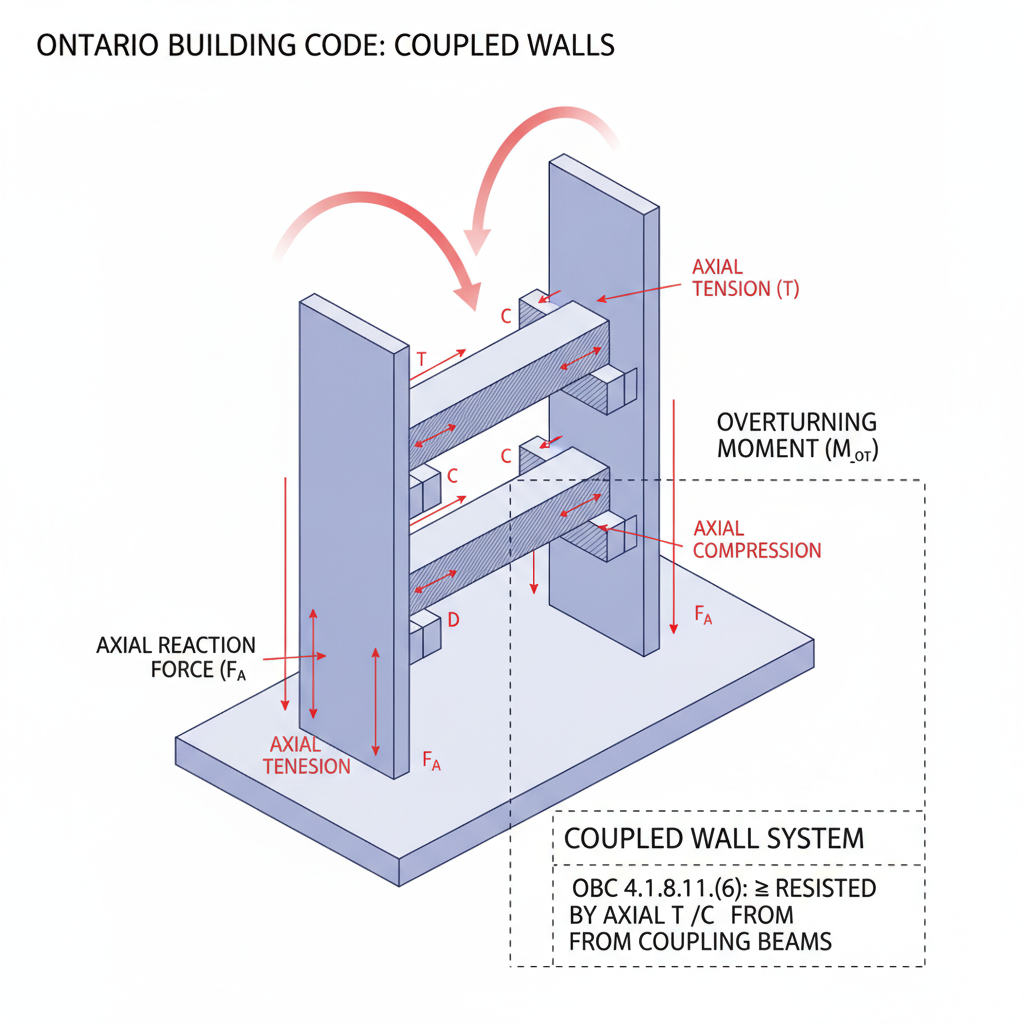
A "coupled" wall system is a specific engineering designation where at least 66% of the base overturning moment is carried by axial tension and compression forces. Proper identification of these systems is essential for accurate load distribution in multi-storey builds.
Calculating Overturning Moments (Mx)
The overturning moment at any level (Mx) is determined by the summation of lateral forces adjusted by the reduction factor (Jx). The code provides specific formulas where Jx remains 1.0 for heights greater than 60% of the building height, while applying a reduction factor for lower levels to optimize material efficiency without sacrificing safety.
Managing Torsional Effects and Sensitivity
Torsional sensitivity (Bx) is a critical metric calculated by the ratio of maximum storey displacement (δmax) to average displacement (δave). The code requires designers to account for accidental eccentricities (± 0.10 Dnx) to ensure the building does not undergo excessive rotation during an earthquake.
Compliance for Torsional Load Cases
For buildings with a sensitivity ratio (B) of 1.7 or less, torsional effects must be accounted for by applying specific moments (Tx) about the vertical axis. This ensures that every element of the building is designed for the most severe possible load case.
Disclaimer: This content is generated from the Ontario Building Code for educational purposes. Always consult with a licensed professional engineer or your local building department before starting any construction project in London, Ontario.