2024 Ontario Building Code Seismic Design: Site Stability and Component Requirements
Sarah's Expert Insight
OBC Compliance Specialist
"At empcontracting.ca Inc., your construction contractor in London, Ontario, we find that Article 4.1.8.18 is frequently the most critical yet misunderstood section during commercial tenant improvements. Whether we are installing heavy HVAC systems in London or securing equipment in high-wind zones like Oakville, ensuring that non-structural components are seismically anchored is vital for both code compliance and long-term liability protection."
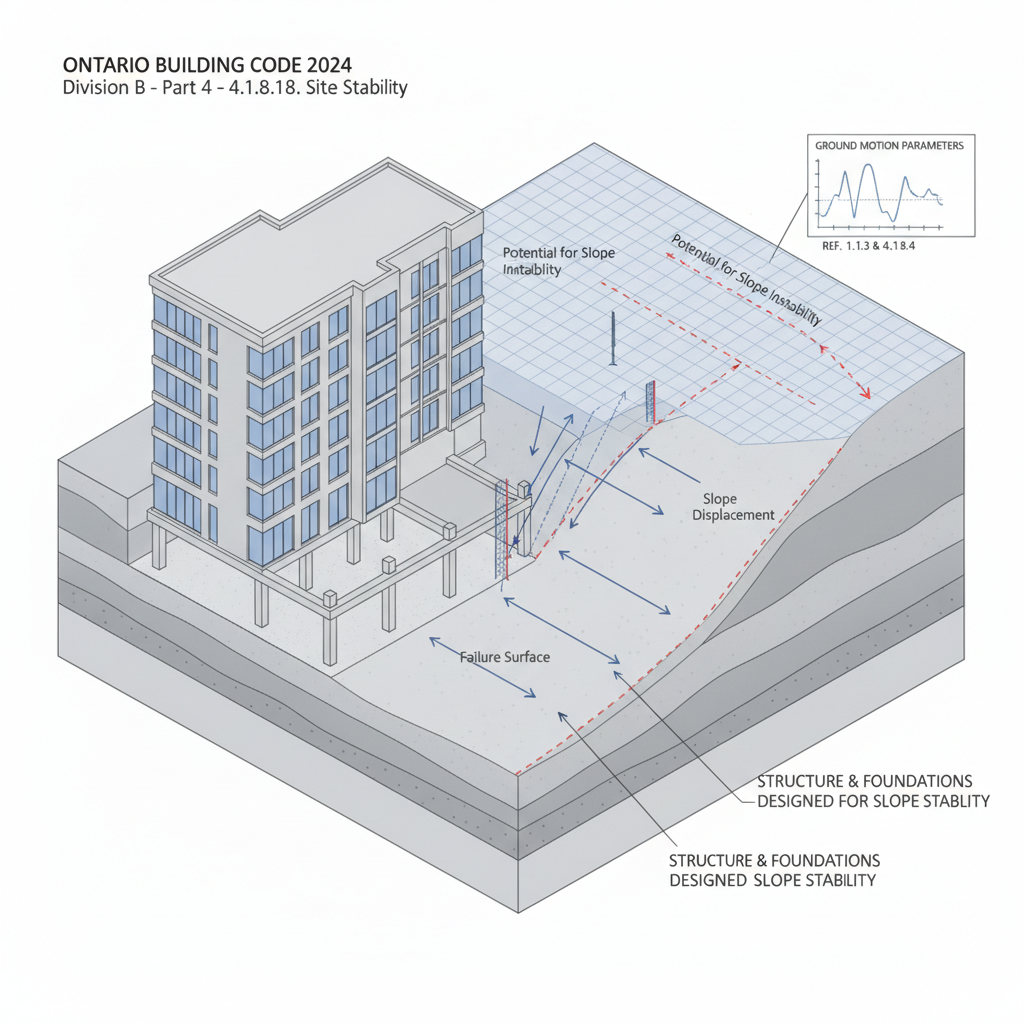
Understanding OBC Section 4.1.8.17: Site Stability and Slope Displacement
According to the 2024 Building Code Compendium, ensuring site stability is a foundational requirement for any construction project. Article 4.1.8.17 mandates that the potential for slope instability and displacement must be evaluated based on site-specific material properties and ground motion parameters. These factors must be integrated into the design of the structure and its foundations to mitigate risks associated with seismic activity. Working with empcontracting.ca Inc. your construction contractor in London, Ontario, ensures that these complex geotechnical evaluations are handled with precision.
Compliance with Ground Motion Parameters
The code requires that designers reference Subsection 1.1.3 and Article 4.1.8.4 to determine the necessary modifications for ground motion. This is critical for maintaining structural integrity in areas prone to soil shifting or varying spectral acceleration.
Section 4.1.8.18: Non-Structural Components and Seismic Force (Vp)
Article 4.1.8.18 focuses on the elements of structures, non-structural components, and equipment. These items—ranging from mechanical units to architectural partitions—must be designed to withstand lateral earthquake forces (Vp). The code provides a specific formula: Vp = 0.3S(0.2)IeSpWp, where factors like spectral acceleration, importance, and component weight are all weighed against the building's deflection.
Specific Requirements for Heavy Machinery and Tanks
Sentence (5) highlights a critical threshold: if a tank or a flexible piece of machinery exceeds 10% of the mass of the supporting floor, a rational analysis must be performed. This prevents the dynamic load of the equipment from negatively impacting the structural performance of the floor during a seismic event.
Flexible vs. Rigid Connections
For Categories 11 and 12, the code distinguishes between flexible and rigid connections based on the fundamental period of the component (0.06 s threshold). Ensuring the correct classification is essential for calculating the force amplification factor (Ar) and the response modification factor (Rp). For expert guidance on these technical specifications, consult with empcontracting.ca Inc. your construction contractor in London, Ontario.
Disclaimer: This content is generated from the Ontario Building Code for educational purposes. Always consult with a licensed professional engineer or your local building department before starting any construction project in London, Ontario.