Ontario Building Code 2024: Essential Standards for Plastic Piping, Fittings, and Solvent Cements
Sarah's Expert Insight
OBC Compliance Specialist
"At empcontracting.ca Inc., your construction contractor in London, Ontario, we frequently see errors in the field regarding the misuse of transition cements and temperature-rated composite pipes. Ensuring that your plumbing infrastructure—especially in high-density areas like Oakville or custom Muskoka cottages—meets the 320 kPa stiffness requirement and specific fire-stop protocols is non-negotiable for passing inspections and ensuring long-term structural safety."
When navigating the complexities of the 2024 Building Code Compendium, specifically Division B – Part 7, it is essential for developers and builders to adhere to the strict material standards for drainage and potable water systems. As the leading experts at empcontracting.ca Inc. your construction contractor in London, Ontario, we ensure every installation meets these rigorous CSA and ASTM requirements.
Section 7.2.5.10: Transition Solvent Cement Requirements
Transitioning between different plastic materials requires specific bonding agents to ensure system integrity. Under OBC 7.2.5.10, solvent cement for transition joints must conform to CSA B181.1 or B181.2 standards. Crucially, transition solvent cement is strictly limited to joining ABS drainage systems to PVC drainage systems.
Section 7.2.5.11: Plastic Piping and Fittings Inside Buildings
Sanitary and Venting Systems
For sanitary drainage or venting systems located inside or under a building, the code mandates compliance with ASTM F628, CSA B181.1, or CSA B181.2. This ensures that the cellular core and rigid structures are capable of handling the internal environmental stresses of a permanent structure.
Storm Drainage Systems
Storm drainage systems within buildings have broader material options but maintain high performance standards, including CSA B182.1 and B182.2. All plastic pipes used in these applications must maintain a pipe stiffness equal to or greater than 320 kPa to prevent structural failure under load.
Fire Safety and Combustibility
A critical component of OBC compliance involves the intersection of plumbing and fire safety. Piping that pierces fire separations or fire blocks must adhere to specific fire-stopping requirements outlined in Subsection 3.1.9 and Article 9.10.16.4. ensuring the building's fire-rated integrity is not compromised by the plumbing layout.
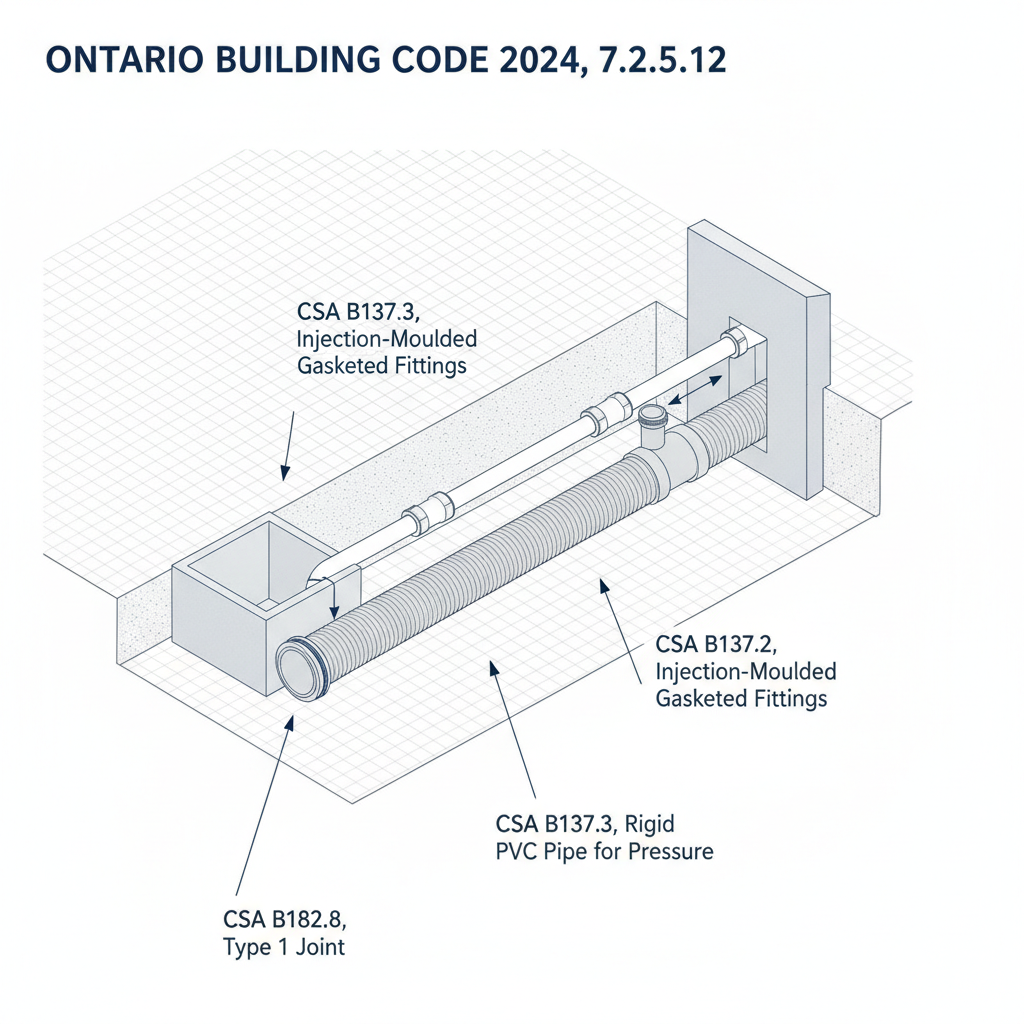
Section 7.2.5.12: Polyethylene/Aluminum/Polyethylene (PE/AL/PE) Composite Pipe
Composite piping used for potable water must conform to CSA B137.9. While these pipes are versatile, the OBC 2024 restricts their use in hot water systems unless the pipe carries a specific pressure rating of 690 kPa or greater at a temperature of 82ºC.
Disclaimer: This content is generated from the Ontario Building Code for educational purposes. Always consult with a licensed professional engineer or your local building department before starting any construction project in London, Ontario.