Ontario Building Code Section 7.3.3: Master Guide to Plumbing Connections for London, Ontario Construction
Sarah's Expert Insight
OBC Compliance Specialist
"Compliance with Section 7.3.3 is vital in regions like London and Muskoka, where extreme temperature shifts demand robust allowances for pipe expansion and contraction to avoid burst lines. At empcontracting.ca Inc. your construction contractor in London, Ontario, we pay meticulous attention to the prohibition of underground compression fittings beneath slabs, ensuring your build remains leak-free and fully compliant with the 2024 Compendium."
Mastering OBC Section 7.3.3: Plumbing and Material Integrity
For any residential or commercial project, adhering to the 2024 Ontario Building Code (OBC) is essential for safety and longevity. Below is an expert breakdown of the standards for joining materials and managing plumbing systems as followed by empcontracting.ca Inc. your construction contractor in London, Ontario.
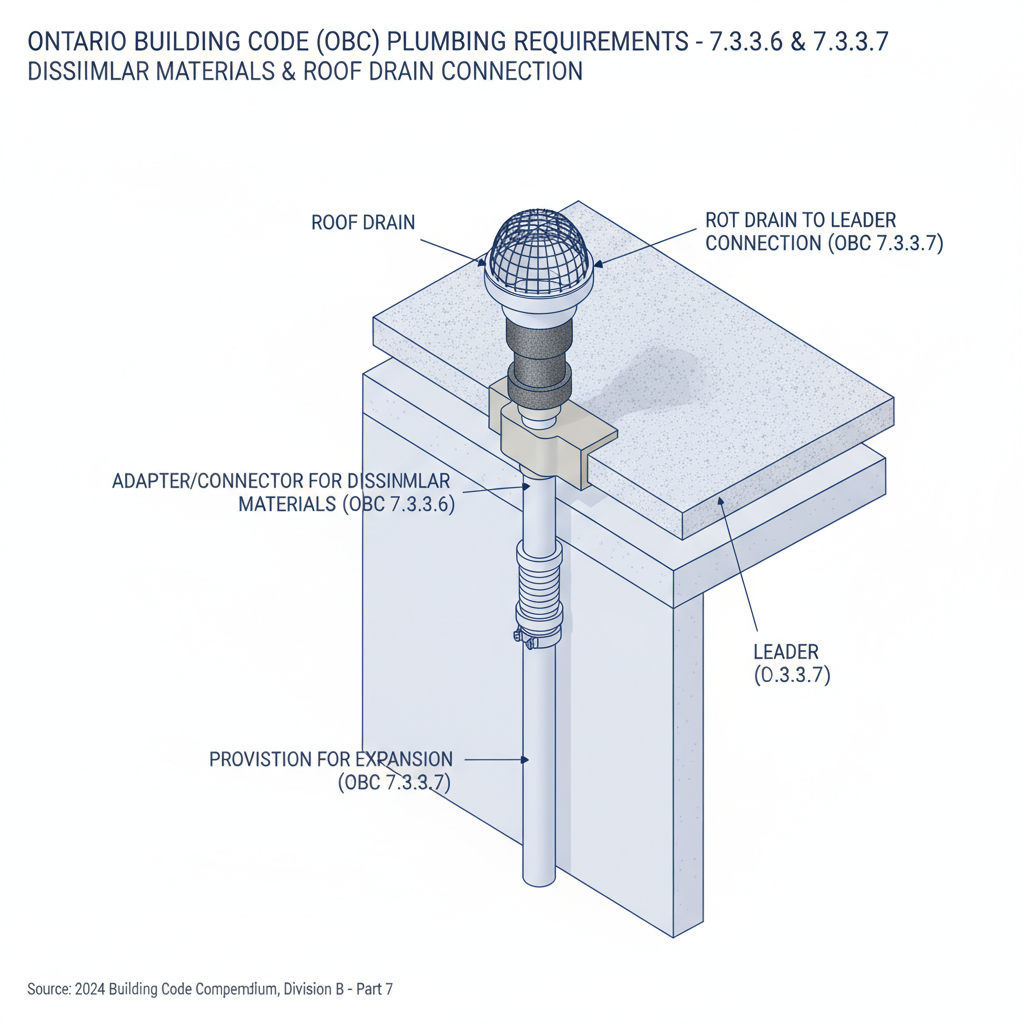
7.3.3.6. & 7.3.3.7. Joining Dissimilar Materials and Roof Drains
Adapters, connectors, or mechanical joints used to join dissimilar materials must be specifically designed to accommodate the transition. Furthermore, roof drains must be securely connected to a leader with provisions made for thermal expansion to prevent structural water damage.
7.3.3.8. Connection of Floor or Wall Outlet Fixtures
Specific standards apply to the installation of pedestals, water closets, and S-trap standards:
- Fixtures must be connected via a floor flange (typically brass, or matching material for cast-iron/plastic pipes).
- All flanges and fixtures must be set on a firm base and securely fastened.
- Joints must be sealed with a resilient, watertight, and gas-tight seal to ensure sanitary safety.
- If using a lead water-closet stub, the length below the flange must be at least 75 mm.
7.3.3.9. & 7.3.3.10. Expansion, Contraction, and Copper Tubing
Every piping system must be designed to accommodate expansion and contraction caused by building shrinkage or temperature changes. Regarding copper, Types M and DWV copper tube cannot be bent; any bends in soft copper must be made with tools specifically sized for that purpose.
7.3.3.11. & 7.3.3.12. Indirect Connections and Underground Copper
Indirect connections require an air break of at least 25 mm above the flood level rim. For underground copper joints, flared, compression, or brazed fittings are required, though compression fittings are strictly prohibited underground beneath a building.
Disclaimer: This content is generated from the Ontario Building Code for educational purposes. Always consult with a licensed professional engineer or your local building department before starting any construction project in London, Ontario.