2024 Ontario Building Code: Grease Interceptors and Trap Requirements for Commercial Construction
Sarah's Expert Insight
OBC Compliance Specialist
"As a senior consultant at empcontracting.ca Inc. your construction contractor in London, Ontario, I cannot overstate the importance of precise flow rate calculations for grease interceptors in commercial kitchens across London and Oakville. Improperly sized interceptors or incorrect 'gang trapping' of floor drains are common points of failure during municipal inspections in the Muskoka region; our team ensures every installation meets the 38 mm water seal and flow control standards to guarantee long-term compliance."
Navigating the complexities of the 2024 Building Code Compendium is essential for compliant plumbing and drainage systems. This section details the specific requirements for grease interceptors, neutralizing tanks, and the proper application of traps in sanitary drainage systems.
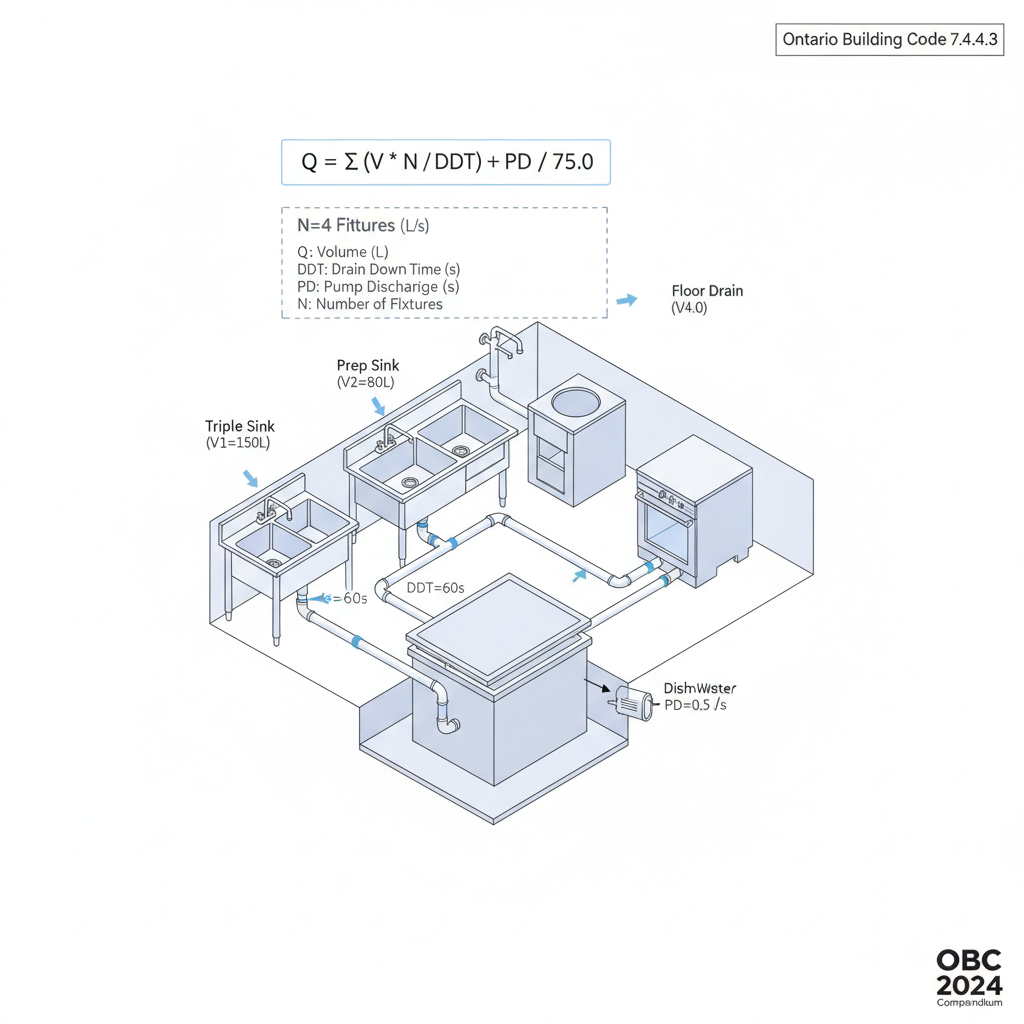
7.4.4.3. Grease Interceptor Flow Rates and Controls
According to the OBC, the flow rate through a grease interceptor must never exceed its rated capacity. The code provides a specific formula for calculation, where Q (flow rate in L/s) is derived from V (fixture volume), DDT (drain down time of 60 or 120 seconds), and PD (pump discharge).
Flow Control Mechanisms
All grease and oil interceptors are required to have an internal flow control. In instances where the head exceeds five feet, a secondary flow control must be installed to manage pressure and ensure efficient separation.
Oil Interceptor Exceptions
Floor drains conforming to Sentence 7.4.5.1.(3) do not require separate trapping and venting; they may be gang trapped when discharging specifically through an oil interceptor.
7.4.4.4. Neutralizing and Dilution Tanks
For facilities handling corrosive or acid waste, the OBC mandates the use of neutralizing or dilution tanks. These must connect to the sanitary drainage system via a trap or an indirect connection and must possess a reliable method for neutralizing the liquid before it enters the main system.
7.4.5.1. Traps for Sanitary Drainage Systems
Standard practice requires fixtures to be protected by a separate trap, though several key exceptions apply for efficiency:
Single Trap Allowances
- Multi-compartment fixtures: A single trap can serve 2- or 3-compartment sinks or laundry trays.
- Similar fixtures: Two similar single-compartment fixtures in the same room may share a trap.
- Grouped drains: Floor drains, hub drains, shower drains, or laboratory sinks in the same room can be served by a single trap, provided they do not receive organic matter or food waste.
Interceptors as Traps
An interceptor with an effective water seal of at least 38 mm is permitted to function as a trap under Sentence 7.4.5.1.(5).
Disclaimer: This content is generated from the Ontario Building Code for educational purposes. Always consult with a licensed professional engineer or your local building department before starting any construction project in London, Ontario.