Understanding Ontario Building Code 2024: Applications of Part 3 and Part 9 Regulations
Sarah's Expert Insight
OBC Compliance Specialist
"Determining whether your project falls under Part 9 or Part 3 is the most critical first step in the Ontario design process, as it dictates everything from fire separation to professional engineering requirements. At empcontracting.ca Inc. your construction contractor in London, Ontario, we specialize in navigating these thresholds for residential and commercial builds in London, Oakville, and Muskoka to ensure compliance and project efficiency."
Introduction to Building Code Classifications
Navigating the 2024 Building Code Compendium is essential for any successful development. Article 1.3.3.2 and 1.3.3.3 define the scope of how specific regulations apply to different building types, based on their size, height, and intended occupancy.
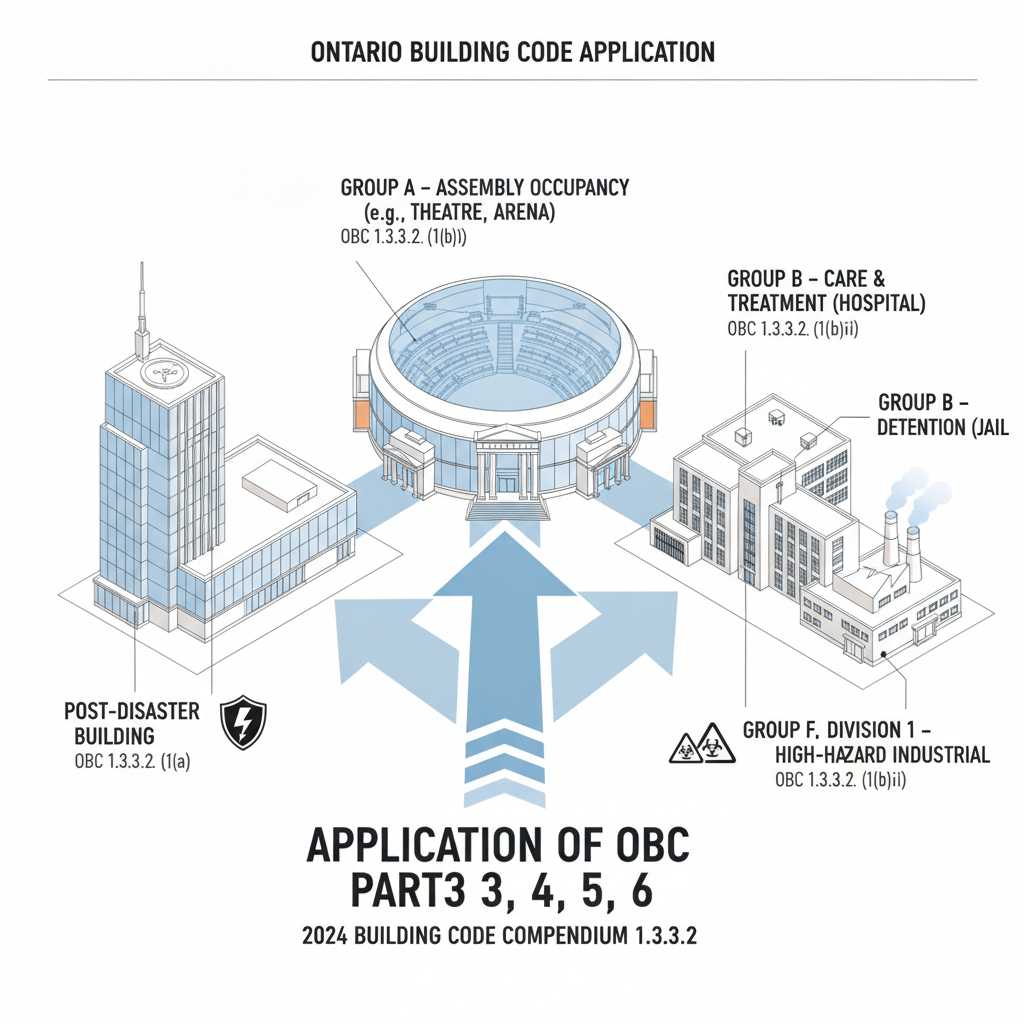
Application of Parts 3, 4, 5, and 6: Large and Complex Buildings
Part 3 of the OBC typically applies to larger buildings and those with complex occupancy requirements. Subject to specific exceptions, these parts apply to all buildings classified as:
- Post-disaster buildings: Facilities that must remain operational during emergencies.
- Major Occupancies: Including Group A (Assembly), Group B (Care/Detention), and Group F, Division 1 (High-hazard industrial).
- Large Scale Projects: Any Group C (Residential), D (Business), E (Mercantile), or F2/F3 (Industrial) buildings that exceed 600 m² in area or 3 storeys in height.
Specialized Structures Under Part 4
Beyond standard buildings, Part 4 regulates specific structures including retaining walls over 1,000 mm high adjacent to public property, pedestrian bridges, crane runways, large wind turbine supports, and outdoor pools with depths exceeding 3.5 m.
Application of Part 9: Small Buildings and Residential Projects
Part 9 is the most common section for residential and small-scale commercial construction. It applies to buildings of 3 storeys or less with a building area not exceeding 600 m². These include:
- Group C Residential occupancies (excluding retirement homes).
- Group D Business and Personal Services.
- Group E Mercantile occupancies.
- Group F, Divisions 2 and 3 Industrial occupancies.
For expert navigation of these complex requirements, trust empcontracting.ca Inc. your construction contractor in London, Ontario, to ensure your project meets every regulatory threshold from the start.
Disclaimer: This content is generated from the Ontario Building Code for educational purposes. Always consult with a licensed professional engineer or your local building department before starting any construction project in London, Ontario.