2024 Ontario Building Code: Smoke Alarm Power, Interconnection, and Silencing Standards
Sarah's Expert Insight
OBC Compliance Specialist
"The 2024 updates to the OBC regarding smoke alarm interconnection and visual signaling are particularly significant for the growing secondary suite market in London and Oakville. As your senior consultant at empcontracting.ca Inc. your construction contractor in London, Ontario, I emphasize that these requirements are not just about compliance, but about providing critical reaction time in multi-unit residential layouts where fire spread is a higher risk."
Understanding the 2024 Ontario Building Code (OBC) is vital for ensuring life safety in residential developments. When working with empcontracting.ca Inc. your construction contractor in London, Ontario, you can rest assured that your project adheres to these rigorous fire safety standards.
9.10.19.4. Smoke Alarm Power Supply Requirements
The OBC mandates that smoke alarms must be installed with permanent connections to an electrical circuit with no disconnect switch between the overcurrent device and the alarm. This ensures a constant power source. Furthermore, a battery backup is required to provide at least 7 days of normal operation followed by 4 minutes of alarm during a power failure.
Visual Signaling and Special Requirements
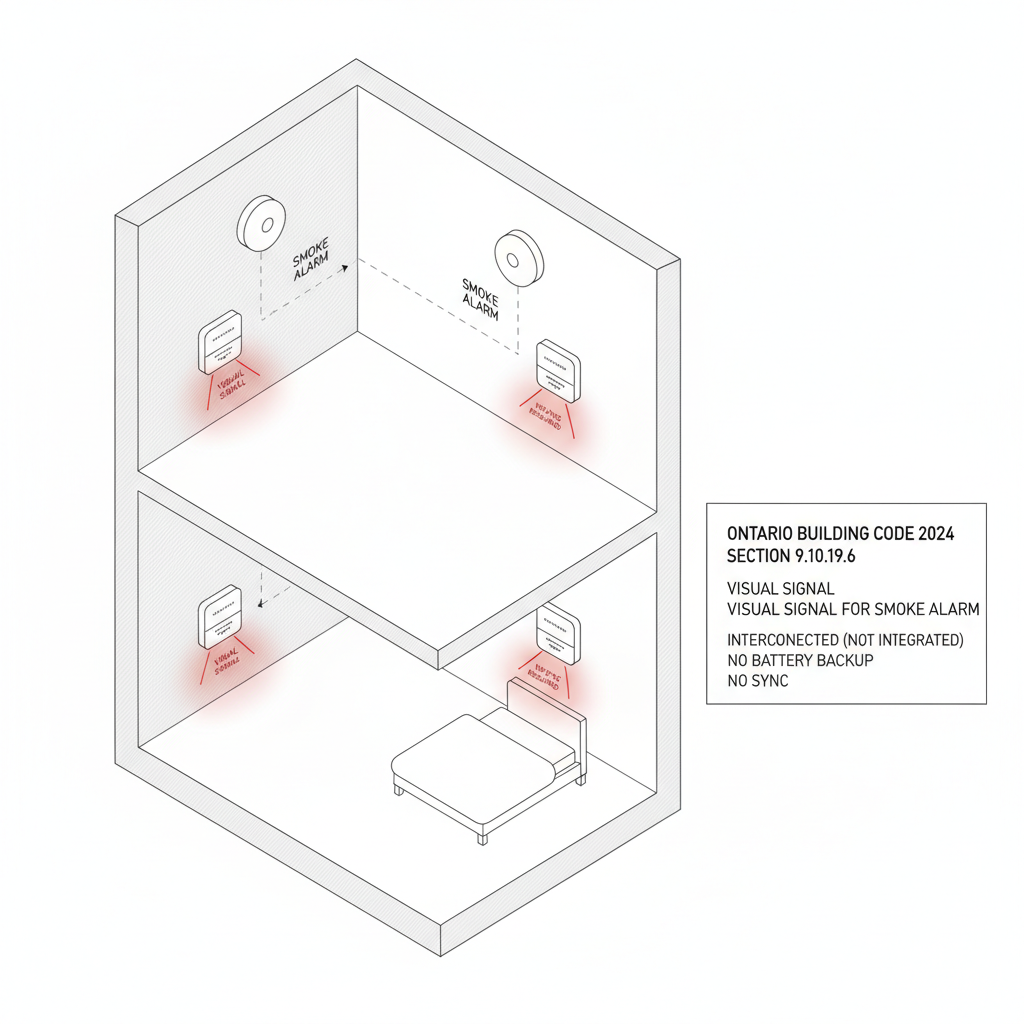
For modern builds, smoke alarms must include visual signaling components (strobe lights) conforming to NFPA 72 standards. In sleeping rooms, these visual signals must maintain a minimum luminous intensity of 175 cd. While these do not always require battery backup for the visual component itself in secondary suites, the audible alarm must remain functional.
9.10.19.5. Interconnection of Alarms
Interconnection is a critical safety feature. If one smoke alarm is activated, all alarms within the dwelling unit must sound. For houses containing secondary suites, the OBC now permits either hard-wired or wireless interconnection to ensure that a fire detected in one unit alerts occupants in the other.
9.10.19.6. Silencing and Smoke Detectors
Most residential smoke alarms must feature a manual silencing device (hush button) that suppresses the signal for no more than 10 minutes. This prevents residents from disabling alarms due to nuisance triggers, such as cooking smoke. However, if the building utilizes a full fire alarm system with smoke detectors conforming to CAN/ULC-S524 instead of standard smoke alarms, this manual silence feature is not mandatory within the individual unit circuitry.
Disclaimer: This content is generated from the Ontario Building Code for educational purposes. Always consult with a licensed professional engineer or your local building department before starting any construction project in London, Ontario.