2024 Ontario Building Code Vapour Barrier Standards: Expert Guide for London Construction
Sarah's Expert Insight
OBC Compliance Specialist
"In the fluctuating climates of London, Oakville, and Muskoka, moisture management is the foundation of a durable home. At empcontracting.ca Inc., we prioritize the 'warm side' installation rule and high-spec materials to prevent the hidden condensation that leads to mold and structural decay in Ontario residences."
Understanding the 2024 Ontario Building Code (OBC) is essential for any renovation or new build. Section 9.25.4 specifically addresses the critical role of vapour barriers in maintaining the structural integrity of your home. When working with empcontracting.ca Inc. your construction contractor in London, Ontario, we ensure every project meets these rigorous provincial standards to protect against moisture damage.
9.25.4.1. Required Barrier to Vapour Diffusion
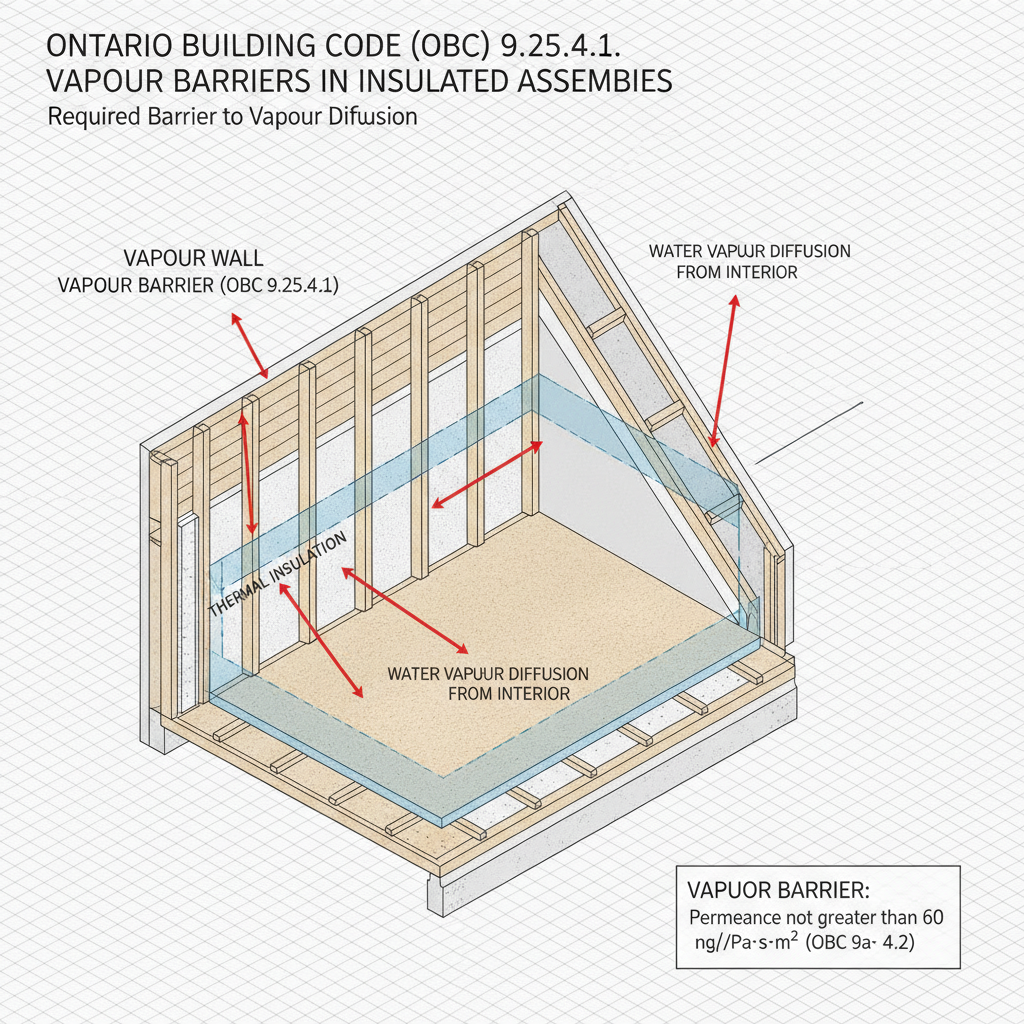
The OBC mandates that all thermally insulated wall, ceiling, and floor assemblies must include a vapour barrier. This barrier is designed to prevent water vapour from moving from the warm interior of your home into sensitive areas like wall cavities, attic spaces, or floor assemblies where it can condense and cause structural rot.
9.25.4.2. Approved Vapour Barrier Materials and Permeance
Standard Material Requirements
In accordance with Section 9.25.4.2, most vapour barriers must have a permeance not exceeding 60 ng/(Pa·s·m²). Common materials like polyethylene must comply with specific CAN/CGSB standards to ensure long-term thermal stability and oxidation resistance. If your project uses membrane-type barriers other than poly, they must be protected from UV radiation to prevent material deterioration during and after construction.
Foundations and High-Moisture Areas
Thermally insulated foundation walls allow for variable-permeance barriers, which helps manage moisture more effectively in below-grade environments. For spaces with exceptionally high moisture generation, the assembly must be designed according to the more stringent requirements of Part 5 of the OBC to ensure maximum durability.
9.25.4.3. Strategic Installation for Ontario Climates
Proper placement is the key to effectiveness. The code requires that vapour barriers be installed on the 'warm side' of the insulation. This prevents warm, moist indoor air from hitting cold exterior surfaces and condensing. Whether using dedicated sheets, specific coatings on gypsum board, or thick-layer insulation that functions as its own barrier, the goal is total protection of the building envelope.
Disclaimer: This content is generated from the Ontario Building Code for educational purposes. Always consult with a licensed professional engineer or your local building department before starting any construction project in London, Ontario.