OBC 9.25.5.2 Guidelines: Mastering the Building Envelope with empcontracting.ca Inc. your construction contractor in London, Ontario
Sarah's Expert Insight
OBC Compliance Specialist
"Correctly positioning low-permeance materials is vital for preventing interstitial condensation, especially given the varying heating degree-days in regions like London, Oakville, and Muskoka. As empcontracting.ca Inc. your construction contractor in London, Ontario, we meticulously calculate these thermal resistance ratios to ensure your building envelope remains durable and moisture-free throughout Ontario's harsh seasonal shifts."
Understanding the Ontario Building Code (OBC) is essential for ensuring the longevity and efficiency of any structure. As empcontracting.ca Inc. your construction contractor in London, Ontario, we prioritize the technical nuances of building envelope design to prevent moisture-related issues.
9.25.5. Properties and Position of Materials in the Building Envelope
9.25.5.1. General Requirements
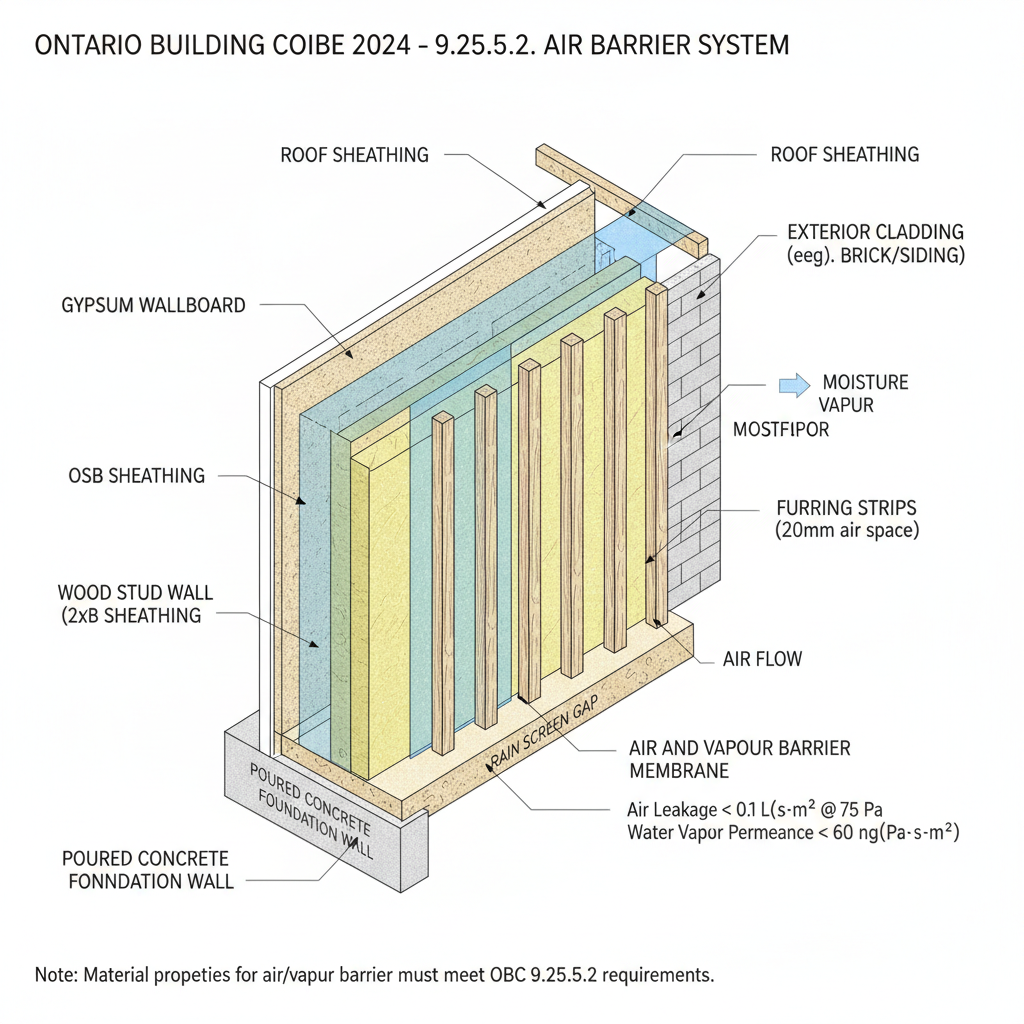
Per the 2024 Building Code Compendium, sheet and panel-type materials used in building assemblies must meet specific air leakage and water vapour permeance standards. Generally, materials must have an air leakage characteristic less than 0.1 L/(s×m²) and a water vapour permeance less than 60 ng/(Pa×s×m²) when tested via the desiccant method.
Exceptions apply for wood-based sheathing under 12.5 mm thick and certain assemblies in locations with fewer than 6000 heating degree-days, provided they maintain specific thermal resistance and permeance levels. However, if the interior space involves high moisture generation, the design must shift to follow Part 5 standards.
9.25.5.2. Position of Low Permeance Materials
The positioning of low permeance materials is critical for vapor control. According to Article 9.25.5.2., these materials must be installed in one of three ways:
- On the warm face of the assembly.
- Outboard of a vented air space.
- At a specific location based on the ratio of outboard-to-inboard thermal resistance.
Table 9.25.5.2: Thermal Resistance Ratios
The OBC provides a strict ratio based on the heating degree-days of the building's location. This ensures that the temperature of the innermost impermeable surface stays above the dew point to prevent condensation. For instance, a location with 5,000 to 5,999 heating degree-days requires a minimum ratio of 0.30, while colder regions exceeding 12,000 degree-days require a ratio of 0.75.
Disclaimer: This content is generated from the Ontario Building Code for educational purposes. Always consult with a licensed professional engineer or your local building department before starting any construction project in London, Ontario.