2024 Ontario Building Code Definitions: Guide to Occupancy Classifications and Live/Work Units
Sarah's Expert Insight
OBC Compliance Specialist
"Accurately identifying your building's 'Major Occupancy' is the first step in securing permits in competitive markets like London and Oakville, as it dictates everything from fire suppression to plumbing requirements. At empcontracting.ca Inc. your construction contractor in London, Ontario, we specialize in interpreting these 2024 updates to ensure your live/work or mercantile space is both code-compliant and optimized for its intended use."
Navigating the complexities of the 2024 Ontario Building Code (OBC) is essential for any successful development project. As a premier provider of construction services, empcontracting.ca Inc. your construction contractor in London, Ontario, provides clarity on the foundational definitions that govern building safety and design.
Key Definitions in the 2024 OBC Compendium
The latest update to the OBC provides specific terminology that dictates how buildings are designed, constructed, and utilized across Ontario. Understanding these terms is the first step in ensuring a project meets provincial safety standards.
Live/Work Units and Industrial Occupancy
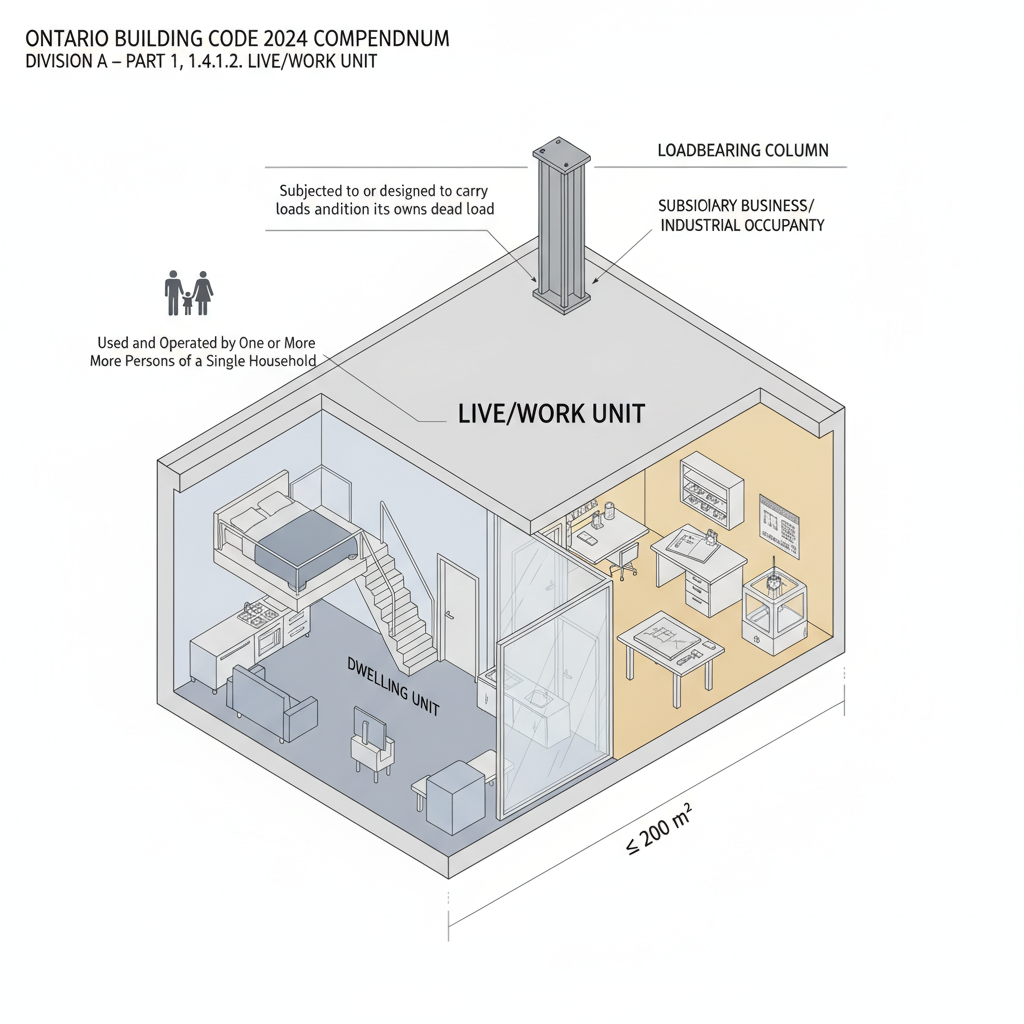
A Live/work unit is defined as a dwelling unit under 200 m² containing a subsidiary business or low-hazard industrial occupancy, operated by a single household. The distinction between Low-hazard (Group F, Division 3) and Medium-hazard (Group F, Division 2) industrial occupancies is vital, as it depends on whether combustible content exceeds 50 kg/m² or 1 200 MJ/m² of floor area.
Major Occupancy Classifications (Groups A through G)
The OBC classifies buildings by their primary use, known as the Major Occupancy. This classification determines fire safety, egress, and structural requirements:
- Group A: Assembly occupancies (Theatres, Arenas, and Open Air)
- Group B: Care, treatment, or detention facilities
- Group C: Residential occupancies
- Group D: Business and personal services
- Group E: Mercantile occupancies (Retail and Goods)
- Group F: Industrial occupancies (High, Medium, and Low hazard)
- Group G: Agricultural occupancies
Structural and Safety Terminology
Designers must also account for specific structural elements such as Loadbearing components, which carry weight beyond their own dead load, and the Means of egress, which ensures a continuous, protected path of travel to a public thoroughfare. Additionally, the code defines a Mezzanine as an intermediate floor assembly between a floor and ceiling, which is a common feature in modern London loft conversions and commercial builds.
Disclaimer: This content is generated from the Ontario Building Code for educational purposes. Always consult with a licensed professional engineer or your local building department before starting any construction project in London, Ontario.