Ontario Building Code Section 9.33: HVAC, Energy, and Safety Standards for London, Ontario Construction
Sarah's Expert Insight
OBC Compliance Specialist
"As a senior consultant at empcontracting.ca Inc. your construction contractor in London, Ontario, I emphasize that adhering to Section 9.33 is vital for long-term air quality and system longevity, especially in the Muskoka and Oakville regions where wood-burning and geothermal systems are popular. Precise CSA F280 load calculations are non-negotiable to prevent equipment short-cycling, ensuring your home remains efficient and comfortable through Ontario's diverse seasonal shifts."
Navigating the complexities of the 2024 Ontario Building Code (OBC) is essential for any high-quality residential or commercial build. At empcontracting.ca Inc. your construction contractor in London, Ontario, we ensure every aspect of your HVAC and air distribution systems meets provincial standards for safety, efficiency, and environmental compliance.
9.33.4. Air Distribution and Contaminant Safety
Asbestos and Air Quality (9.33.4.8)
Per Section 9.33.4.8, asbestos is strictly prohibited within any air distribution systems or equipment. This mandate ensures that indoor air remains free of hazardous fibers, a critical health consideration for all modern construction projects.
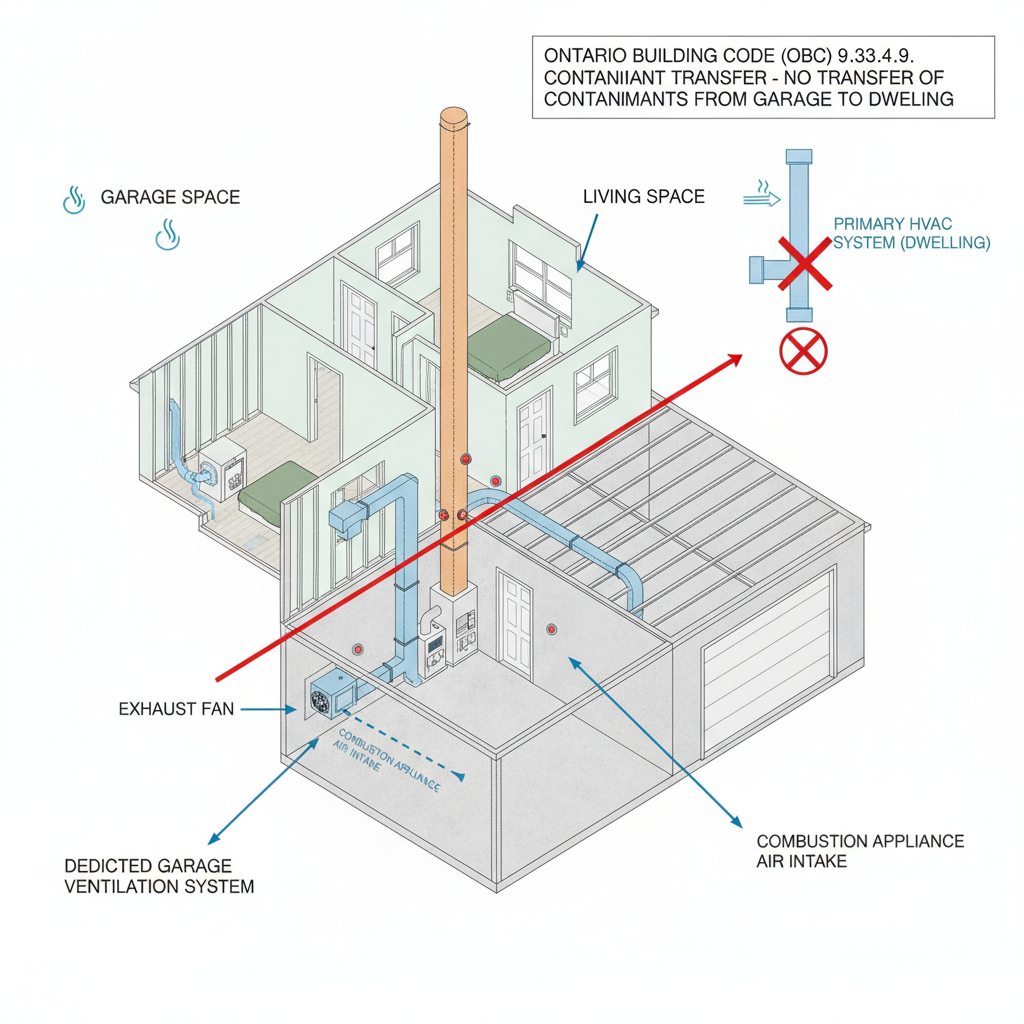
Preventing Contaminant Transfer from Garages (9.33.4.9)
Safety is paramount when designing systems that interact with attached garages. Systems serving or passing through a garage must be engineered to prevent the transfer of carbon monoxide and other hazardous contaminants into the living areas of the dwelling unit.
9.33.5. Heating and Air-Conditioning Capacity and Installation
System Capacity Standards (9.33.5.1)
The OBC requires that heating and cooling capacities be precisely calculated based on CSA F280 standards. This prevents the inefficiencies associated with over-sized or under-sized equipment, ensuring consistent comfort and energy savings.
Earth Energy and Geothermal Systems (9.33.5.2)
For sustainable builds, earth energy systems must conform to CAN/CSA-C448 standards. The code differentiates between residential systems and commercial/institutional buildings exceeding 1,400 m², ensuring the ground heat exchangers are sized correctly for the specific application.
Solid-Fuel-Burning Appliances (9.33.5.3)
Wood-burning stoves, furnaces, and hydronic heating systems are subject to strict installation codes (CSA B365) and particulate emission limits. This ensures that secondary heating sources in Ontario homes are both fire-safe and environmentally responsible.
Disclaimer: This content is generated from the Ontario Building Code for educational purposes. Always consult with a licensed professional engineer or your local building department before starting any construction project in London, Ontario.